Wednesday, March 05, 2008

Something fishy about the origins of Christmas


An effulgence of lights, crowds of zealous shoppers and soul-destroying music announce that it is Christmas time again. But what is Christmas? Who was Christ? Why do we still call this annual shopping spree after this mysterious mythical figure? He dominates our historical consciousness insofar as our understanding of history is determined by before and after his supposed existence, but is there any reason to believe such a figure ever existed in the sense of an actual historical person walking upon the earth? The churches would have us believe that Christ was both God and man, and inspite of this apparent contradiction, actually existed, actually was born on the 25th of December in a stable in Bethleham, performed miracles and died to save humanity. However, close scrutiny of the scriptures and the writings of his contemporaries reveal no evidence of such a person. We are told he came from Nazareth even though this town did not even exist at the reputed date of Christ's birth! The truth is simply that Jesus never existed. He was the result of a complex ideological fiction that took centuries of assiduous editing and re-writing before the New Testament was finally presented as fact. Rather than an historical person, Christ is, to borrow a phrase from the French philosopher Gilles Deleuze, a conceptual person.


Anthropology, however, does show that the idea of Christos or 'The Anointed One' precedes this biblical figure. Adonis and Tammuz, for example, were born of the Virgin Sea-goddess Aphrodite-Maria(Myrrha), or Ishtar-Mari(Hebrew Mariame). In the Bible itself, we have Jehu, son of Nimshi, whom Elijah anointed as a sacred king( 1 Kings 19.16) and Yeshua son of Marah. It is likely that Jesus was another personification of ancient moon worship. The cults of the ancient Essenes always included a healer with the title 'Christos'. The 'chrism' was actually an oil which was used to lubricate the phallus of the statue's of Osiris for penetration by temple virgins in ancient Egypt.


Some theorists have derived the name from 'healing moon-man'. This would fall in with the Hebrew notion that makes Jesus the son of Mary, the almah or 'moon maiden'. It is odd that in spite of Christ's reputed miracles and the oft related furore that surrounded his deeds, that there is no mention of him in any of the renowned scholars of his time. Tacitus, Pliny, inter alia, all eminent scholars and au fait with the events of their time, do not even mention him. This prophetic Jew whose miraculous powers were said to have been considered a threat to the security of the Roman empire, failed to make world-headlines in his day. That is because he wasn't invented until 60 years after his birth when Mark the evangelist sat down to write his first novel! As with all crafy writers, Mark was a skillful plagiarist.He must have been familiar with the writings of Plato, as the Gethsamene episode( 14.32-42) where Jesus continues to pray while the apostles are too drunk to stay awake, is taken straight out of Plato's Symposium. Jesus, like Socrates, just doesn't want the party to end!


One perceptive writer by the name of Aulus Cornelius Celsus, refers to vagabonds and mendicants traversing the Middle East claiming to be the Messiah. He writes:
'Each has the convenient and customary spiel, "I am the god," or "a son of God", or " a divine spirit", and " I have come. For the world is about to be destroyed, and you, men, because of your injustice, will go( with it). But I wish to save, and you shall see me again coming back with heavenly power. Blessed is he who worships me now! On all others, both cities and countrysides, I shall cast eternal fire. And men who( now) ignore their punishments shall repent in vain and groan, but those who believed in me I shall preserve immortal.'
Sound familiar? It was certainly familiar to Celsus but, as you can see, he wasn't too impressed. Of course, the tradition has more or less continued to this day with religious cult leaders still terrorising people into belief. Most of the so-called miracles in the Bible are simply rechauffé stories culled from earlier mythological sources. The changing of water into wine at Canae, for example, was an old trick practised by certain followers of Dionysus. It was a trick involving vessels and sifons which was invented by an engineer named Heron. There were many stories centuries before Christ of priestesses curing the blind with spittle, and Demeter of Eleusis mulitplied loaves and fishes in her role of Mistress of Earth and Sea. Stories of healing the sick and raising the dead were so common at this time that Celsus tells us they were " nothing more than the common works of those enchanters who, for a few oboli, will perform greater deeds in the midst of the Forum... the magicians of Egypt cast out evil spirits, cure diseases by a breath, and so influence some uncultured men, that they produce in them whatever sights and sounds they please. But because they do such things shall we consider them the sons of God?'


The notion of a man-god or god-king sacrificing himself for the sake of his people goes back thousands of years before Christ. This explains the rather cannibalistic ritual of Christianity.In fact, there is very little origininality in the Christian myth. Even the idea of the stable was borrowed from Christ's predecessor Zoroaster, who apparently was born in a stable. The date of Christmas is unsurprisingly nine months after his birth, common to pagan circular theology.There are many more examples which reveal the sources of the Christian myth which I cannot go into here, but what a pity Bishop Theodore of Cyrrhus destroyed up to 200 different Gospels in 250AD, leaving us with only four! As a parting thought, some Irish scholars derived 'Jesus' from the old Irish 'Ischa' meaning fish. Always suspected something fishy myself!
Tá uafás agus díomá ar fud an domhain tar éis bháis de Benazir Bhutto an tseachtain seo caite. Cé nach bhfuil fios fós ag éinne cé a bhí taobh thiar de, is léir go bhfuil sé mar chúis imní agus amhrais istigh sa Phakastáín féin. Tá rialtas na Pakistáine ag maíomh gur ndearna Al Queda an marú. Ach, séanann ceannaire de Al Queda, Mehsud na líomhaintí sin. Níl tharlaíonn sé go minic go shéanann Al Queda líomhaintí a thogtar ina gcoinne nuair a bhíonn siad freagrach. Sé sin a rá go ndealraíonn sé fíor-annamh Al Queda a fheiceáil agus iad a rá nach bhfuil aon bhaint acu leis an ionsaí seo. Is léir dúinn, áfach, go raibh Benazir Bhutto i measc naimhdaithe agus go raibh Al Queda agus na Taliban tar éis bagairtí a dhéanamh go marofaí Bhutto ar ball. Mar sin, feictear dom, go bhfuil rialtas na Pakistáine agus Al Queda ag iarraidh dullamóg a chur a dhaoine mar go bhfuil sé sin usáideach dóibh i dtaobh bolscaireachta de maidir leis an olltoghcháin atá ag teacht. Chiallódh sé sin go bhfuil Rialtas na Pakistáine ag iarraidh am agus spás a fháil chun scéal ceart cuimsitheach a chur le chéile, sceál a chuirfeadh an milleán ar Al Queda. B'fhéidir go bhfuil sé sin fíor, ach tá an PPP ag tabhairt comharthaí amach a insíonn scéal eile. Tugann siad ' conspiracy' ar mharú Bhutto agus ardítear líomhaintí i gcoinne an rialtais dá bharr. Dúirt Tariq Azim Khan, iar leas-aire d'eolais agus é ag caint ar Al Jazeera an tseachtain seo caite,
"caithfimid bheith foigneach le sin agus ba chóir dúinn an inniúchadh ceart a dhéanamh sular ardítear líomhaintí" Dúirt sé chomh maith go dtarlaíonn sé go minic go mbíonn baint ag foréigean i bPakastáin agus an cogadh san Afganistáin. Mar sin, ba chóir dúinn fanacht le go mbeidh fiosrúcháin cheart déanta ar na cúiseanna. Ach le hionsaithe agus ciréibeacha ag leanúint ar aghaidh gach lá ar fud na Pakistáine, níl sé cosúil go mbeidh am ann chun an eachtra seo a inniúchadh roimh thús an olltoghcháin i mbliana. Ní chuirfidh sé sin isteach morán ar Uachtarán Musharaf, áfach, agus beidh sé ag iarraidh bás de Benazir Bhutto a usáid mar chomhartha an antoisctheachais ioslamaigh na tíre agus an fáth bhfuil a rialú riachtanach go fóill.
Is melée amach agus amach atá i gceist i bPakistáin faoi láthair le roinnt forsaí ag iarraidh a bholscaireacht fhéin a chur i bhfeidhm. Dúirt daoine áirithe ba chóir go sheolfar forsaí NA( Na Náisúín Aontaithe) don réigúin chun síochán a chur i bhfeidhm agus chun cinntiú go mbeidh feachtas toghcháin chothrom ann ins na seachtainí romhainn. Beidh súile an domhain ar rialtas na Pakistáine as seo amach maidir le bás Bhutto, go hairithe nuair a smaointear ar ráiteas de Bhutto cúpla mí o shin nuair a dúirt sí go mbeadh rialtas na Pakistáine agus na forsaí slándála taobh thiar de, dá mbeadh iarracht ann chun í a mharú. Anois dealraíonn sé go bhfuil fíor-amhras ann maidir le seasamh an rialtais, amhras atá ag leathnú le ar aghaidh le gach lá.
If the tearful skies and lugubrious winds of January are weighing upon you like lead, perhaps you would be well advised to counteract the gloom by exploring some of the country's incomparable treasures such as Bru na Bóinne or the Boyne Valley in royal county Meath. Access to the Boyne valley will be greatly improved soon as Rialtas na hÉireann proceeds unashamedly to bury 5000 years of civilisation under stone and concrete, enabling you to drive through the valley of Cnoc na Teamhrach, the Hill of Tara, at your leisure in your C02-loving SUV! Go n'éirí an bóthar leat! But you won't find a more lugubrious site in Ireland than the Boyne Valley in its present state.In spite of a campaign that has become global to reverse the decision to build the M3 motorway through one of the world's wonders, the Government's pertenacious desire to build this road can only be described as downright perverse. Despite the Government's best efforts, demonstrations against the routing of the M3 motorway are continuing. In a recent press release, the Tarawatch campaign revealed that the office of the Taoiseach tried to prevent the demonstrations of the Tarawatch campaign by officially denying them permission. Nevertheless, the demonstration went ahead. In order to symbolise the destruction of our national heritage, the campaigners made a model of the M3 motorway out of cloth and draped it over the Garden of Rememberance in Dublin. Cait O Riardan from the Pogues and Mary Lou Macdonald from Sinn Féin attended the demonstration as guest speakers.In spite of it being named one of the top ten archeological finds of 2007 by Archeology magazine published by the Archeology Institute of America, the Government has obtusely refused to halt the destruction of the Lios an Mhuillean site in the Tara Skryne Valley. The dishonest and disengenuous stance of the Government is attested by the fact that they moved the destruction date for Lissmullen back to December 18 in a surrepticious attempt to avoid conflict with the Tarawatch campaigners. Instead the NRA handed over the site to the construction company SIAC on December 18. Minister for the Environment and Heritage John Gormely will come in for tough questioning from the Tarawatch campaign about this controversial decision to move the handover date back to before Christmas. Speaking at the recent demonstration in the Garden of Rememberane, Mary Lou Macdonald was vociferous in her condemnation of Gormely's position on the Tara valley project.

"The Minister has flouted EU law since he came into office, by refusing to conduct a dew Environmental Impact Assessment on Tara.
"The Green Party Minister for the Environment has completely adopted the Fianna Fail position and rejected demands by Environment Commissioner, Stavros Dimas, to re-assess the damage being done to heritage there." she said.
While Vincent Salafia of TaraWatch said:
"Not only is Minister Gormley lying about having the power to order a new assessment, but he appears to have given false information to the public about the date of the transfer of Lismullin, in order to facilitate demolition over the holidays.
"The lawsuit being taken by the European Commission could cost the taxpayer tens of millions of euros in fines, and it is the Minister’s duty to avoid these penalties."
Perhaps 2008 will be a year of introspection for the Government and the average Irish citizen. With the Achilles heal of the Irish economy, namely the construction sector in obvious decline, together with a looming recession in the USA, it is time to take stock of the importance of culture and heritage before it is too late. If nothing else, the Tara Skryne Valley serves to show us that although the life of man is short, nasty and brutish, his wretched sojourn upon the earth is redeemed by the works of art he leaves behind, filling us with wonder and enjoining us to think in the words of Shakespeare's Hamlet that there are more things in heaven and earth than are dreamt of in our philosophies. Much damage has already been done but if the national monuments that challenge the complacency of the present with the imprint of the past are erased, what will we have to reflect upon, where will we look for answers to the big questions, the questions of our origins, of who we were, who we are and who we might be in the future?
Porqué no te callas? Cén fáth nach bhfuil Chavez cúin?
"Porque ne te callas?!" b'shin na focail a chualathas ar fud an idirlíon; ráiteas borb a d'eascair as argóint idir an Rí Juan Carlos na Spáinne agus Hugo Chavez, uachtarán de Venezuela sa Cruinniu Ibero-Mhearicánan mí na saimhna i 2007. Bhí díospóireacht maidir le polasaí na Spáinne comhlachtaí príomháideacha a chothú ar fud an réigúin faoi lánsheol nuair a bhriseadh an argóint amach. Ach nuair chuala muid morán faoi na chúiseanna a bhí taobh thiar den easaontas. Cuireadh an chuid béime ar iontas an lucht lanúna maidir le ráiteas an rí, agus anois tá na páipéirí spáinneacha ag caint faoi 'relationes dificiles' le rialtas de Chavez dá bharr. Ach ní raibh morán caint faoin díospóireacht ar chor ar bith. Níor bhain sé le stair de Mheiriceá Theas amháin ach le polasaithe eacnamaíochta príobháideacha a bhí freagrach de bhochtanas agus éadóchas ar fud na mór-roinne súid. Ach e sin ráite, ní raibh morán eolais againn ó na tuairiscí a fuair muid faoi céard go díreach a bhí i gceist ann. Bhí roinnt uachtaráin Mheiriceá Theas, daoine mar Evo Morales den Bholaiv, Carlos Lage de Cuba agus Daniel Ortega de Nicaragua agus iad ag maíomh gur ba chóir go mbeadh muster eacnamaíochta nua ann chun dul i ngleic le bearna ollmhór atá idir saibhir agus daibhir sa tír. Tá sé soléir dóibh gur scrios na comhlachtaí idirnáisiúnta alán tíortha ar fud Mheiriceá Theas nuair a cuireadh i bhfeidhm polasaithe eacnamaíochta nua-liobrálacha sna hochtaidí. Mar sin, ní raibh siad ach ag déanamh tagairt don réalachas mar a fheictear go forleathan imeasc a bpobal féin. Ach ní raibh Rí Juan Carlos sásta líomhaintí i gcoinne a hiar-chéad aire José Maria Aznar a chloisteál, mar tá sé aitheanta do gach éinne gur d'imir Aznar ról lárnach mar aire i ndeachtóireacht de Franco go dtí na seachtóidí. Thaobhaigh Aznar le coup d'etat a bheartaigh an CIA i Venezuela i 2002, agus ó shin i leith, mhaslaigh sé Chavez le gach deis a fuair sé, a rá go raibh Uachtarán de Venezuela ina chontúirt de dhaonlathas na tíre agus sé sin ó fhear díograiseach do dhéachtóireacht fhaistísteach na Spáinne! Nuair a tháinig sé os comhair chomissúin um ghnóthaí eachtracha sa Spáinn i 2004, dúirt an t-aire um ghnóthaí eachtracha Migel Angel Moratinos go raibh coup d'etat ann agus go fuair ambassadóir na Spáinne ordaithe ó Rialtas na Spáinne glacadh leis an coup agus tacaíocht a thabhairt dó. Níl amhras ach gur chuir sé sin isteach ar Rí na Spáinne. Theastaigh uaidh nach n-osclofaí an t-eolas sin os comhair an domhain. Fuair sé tacaíocht ó mheán cumarsáide an domhain nuair a chraol siad a ráiteas amháin gan trácht ar na fáthanna a bhí taobh thair de.
Tá cás na Venezuela ag cur isteach ar na Stáit Aontaithe os rud é go bhfuil plean forbartha náisiúnta acu chun neamspleáchas a bhaint amach ó 'Uncle Sam'. Mar sin, tuairisc ina dhiaidh tuairisc ón tír súid ag déanamh masla do Chavez. Rinne na Spáinnigh an rud céanna faoi stúirthóireacht de Aznar. Nuair a smaoinítear ar na tíortha eile sa Mheiriceá Theas atá ag baint neamhspleáchais amach óna Stáit Aontaithe is léir go bhfuil cinneál réabhlóid chúin ag tarlú ann. In ainneoin sin is uile, theip ar Chavez le déanaí bunreacht na tíre a athrú le go mbeadh sé mar uachtarán buan. Comhartha é sin go bhfuil bolscaireacht an daonlathais liobrálaigh ag bailliú nirt sa tír.Ach é sin ráite,níl aon freagair acu d' fadhbanna na tíre agus bheadh orthu Weltanschaunng go hiomlán difrúil ach éifeachtach do gach éinne ag an am céanna a thaispéaint do dhaoine dá éireoidh leis an 'oligarchy' an lámh in uachtar a fháil arís. Ach cén liobrálachas atá i gceist acu le sin i ndáiríre? Liobrálachas a choinnfidh an bhearna idir saibhir agus daibhir i bhfeidhm agus seanréimeas coilíneach a dhúiltíonn deiseanna do dhaoine bochta, alán bundúcasaigh ina measc. B'fhéidir go raibh ciall áirithe ag baint le ráiteas an rí: mas theastaíonn uait athruithe radacacha sóisialacha a chur i bhfeidhm, dún do bhéal! Ach tá tromlach na daoine ag cúlú le Chavez go fóill agus is iadsan a fhreagróidh an cheist sin ' porque no te callas'. Porque consequimos una revolution!
Gluais
díospóireacht
easaontas
dhaonlathas
díograiseach
bolscaireacht
bundúcasaigh

Why the Irish education system is murdering our language


Sitting in a musty room overlooking the rain-drenched january streets of Cork, an opened book before me and a somewhat apprehensive face meeting my eyes at the other side of the table. I am teaching Irish for the dreaded Ardteistiméireacht. Realising the dismal state that secondary Irish education now finds itself in, a half-hearted caricature of language acquisition; or as someone once said, the inculcation of the impossible to the indifferent by the incompetent- I try to engage my student in trivial small talk as Gaeilge hoping that such tentative confabulation would generate sufficient interest to maintain our tremulous amity.


It's not that Irish is depressing or anything, it's just that the travesty of real learning disguised under copious notes perfunctorily swallowed by Ireland's leaving cert students, saps the 'spontaneous joy and natural content', as Yeats put it, from the hearts of our children, drying the cultural marrow of the nation and replacing it with a cancer of ignorance. And I am continually astonished by the level of ignorance that passes for linguistic competence.All over Ireland, leaving cert students are learning off reams of poetry, quotations from short stories of dubious merit, without being able to express their most basic concerns in the language. It is an open secret. We all did it. I look at a copy book of one student and see essay's reasonably well-written, grammatical exercises completed satisfactorily and letters written without too many errors, yet the same student is not able to form one sentence in the language, nor understand the most basic chunk of syntax. But he is one of many.


Let's face it, the Irish revival project under the aegis of An Roinn Oideachais agus Eolaíochta has failed. It is over. It will not improve nor does it deserve to. It is a disgrace and a smug obfuscation of the aims and aspirations of the cultural idealists who fought for national self-determination. As I speak the Government are attacking one of the last havens of propror Irish language instruction,Pobalscoil Chorca Dhuibhne in Kerry for speaking the language too much! I know, it is perverse, and despicably so.


As it stands, mainstream Irish education in this country is a waste of time. Should we then abandon the language, abandon this umbilical cord that binds us to one of the world's richest and most mysterious cultures? Of course not. But the leaving cert syllabis needs to be scrapped. We need to start again. We need drama, role-play, continuous assessment based on interviews, rigorous oral Irish training for teachers, a national educational programme that would provide incentives for schools willing to make the language a living medium of communication inside and outside the classroom.


Instead the Government routinely refuses to supply the most meagre funding or State support to the Gaelscoileanna movement. We need schools where teachers show example by being heard converse as Gaeilge to each other in the corridors and on the sports fields. We need to make the assessment process 80 percent oral. We need inspectors making regular checks on schools, university students perhaps, who could engage students in conversation in the playgrounds as part of their leaving cert examinations. Extra curricular activities through Irish have to be the order of the day. What would happen then?


Irish would become popular, drama activities through Irish would inspire people to consider acting, perhaps in TG4. Why not make the writin of plays as Gaeilge one module of the leaving cert syllabis? Activities performed through Irish would make the subject both easy and enjoyable. The language would become a means of expression again, and would be viewed and the leaving certs results would improve drastically with more people opting of the honours courses. We would then be on our way to a meaning form of diglossia or even pure bilingualism. The murder machine that is the Irish language education system would be decommisioned once and for all, and verbs, adjectives, perpositions and nouns coughed up apathetically in state exams, would begin to signify once again, ensconsing us inextricably with the cultural landscape of the past but more importantly projecting us onto a new plateau of cultural possibility, giving us another way of being, another way of creating the future.

Titim an bhalla ach gan chéilúradh.

Cé go raibh fhios ag daoine ar fud an domhain go raibh smachtbhannaí eacnamaíochta curtha i bhfeidhm i gcoinne mhuintir na Palistíne, cruthaíodh an mheán churarsáide tuariscí a rá go raibh eagla ar mhuinir na hÍosráile mar gheall ar thitim de chuid den bhalla nuair a scrios Hamas é ar na mallaibh. Cúís imní a bhí ann de réir dealramh, cúis imní go mbeadh cead ag sceimhlitheorí dul amú agus trioblóid a chothú le airm ceannaithe, b'fhéidir san Egypt.Codarsnacht rímhór í sin le dearcadh an domhain nuair a thit balla béirlíneach i 1989. Thug titim an bhalla bhéirlíneach gliondar ar mhuintir an domhain, comhartha ba ea é faoi athmhuintearas, faoi dhaonnacht; siombal an daonlathais. Is léir nach bhfuil cothrom le féine i gceist nuair a smaointear faoi phobal na Palistíne, áfach. Cuireadh tuairiscí amach le CNN go raibh 'cúis imní' ar fhorsaí slándála na hÍosráile go raibh 'sceimhlitheoirí' tar éis dul ó smacht, go raibh 'chaos' sa Stráica Gaza agus go raibh ionsaithe de Hamas 'coirúil'. Fuaireamar tuairiscí cosúil le sin anseo in Éireann chomh maith. Dúirt stáisúín na teilifíse nach raibh ach ragús siopadóireachta i gceist acu. Ach ní cheapfá go mbeadh daoine gan acmhaine, gan airgead, gan saoirse agus cearta sibhíalta bunúsacha ag dul i mbun siopadóireachta i stát cóngarach!
Cathain a tharlóidh sé go mbeidh tuiscint nó bá croíúil againn anseo san Iarthar faoi chás na Palistíne? Leannan an foréigean ar aghaidh gan stad gan staonadh agus cloisfimid na bréag ina dhiadh bréag go seasta.
Der réir dealraimh d'oibrigh Hamas ar an dtionscamh seo le roinnt míos ag geartha an bhalla le uirlisí oxy-acetylene. Nuair a thugann tú d'uighe tromlach na bhforsaí slándála san Iosráil agus an dúil cogaíóchta atá acu, chuirfeadh sé iontas ort cé chomh éifeachtach is a bhí an togra uaillmhianach seo. Is mór an bholscaireacht í seo do Hamas agus tá a n-aitheantas, a mheas, tacaíocht agus a n-údarás an-láidir anois i meas an phobail Phalistínigh. Is léir nach bhfuil aon tuiscint ag na meaín chumarsáide san Iarthar, áfach, faoi céard atá ag tarlú sa Phalistín agus mura ndéanfar rud éigin phráineach chun dul i ngleic leis beimid ag breathnú ar an 'holocaust' leanúnach seo le roinnt blianta fós. Coup mór do Hamas agus ba chóir deireadh a chur le dhaorsmacht mhuinir na Palistíne anois!

Dóchas Obama v seanréim Clinton nó McCain.

Tá súile an domhain ag breathnú ar chúrsaí reatha sna Stáit Aonthaithe faoi láthair agus i í an fhirinne nach bhfacha aon duine a leithéid d'aitheantais agus suime i gcúrsaí inmheánacha Mheiriceá b'fhéidir ó tháinig JFK ar stáitse an domhain sna seascaidí. Níl aon amhras ach go bhfuil iarrthóireacht de Bharack Obama an rud is suntasaí agus is suimiúla san olltoghchán seo. Ní amháin mar gheall ar an troid i gcoinne chiníochais, ach toisc go bhfuil Obama ag caint faoi 'athrú' an t-am ar fad. Tá sé ag cur in iúl do dhaoine go bhfuil géarghá d'athrú ann agus nach féidir leis na Stáit Aontaithe gréim a choinneál ar thíortha eile le láthreáin mhileata. Is athrú mór a bheas i gceist anseo agus sin an fáth go bhfuil tromlach de mhuintir an domhain ag súil go roghnófar é mar iarrthóir uachtarántachta ar ball. Tá fhios againn uile go raibh Hillary Clinton i bhfabhar an chogaidh agus nach bhfuil i gceist aici ach leanúint ar aghaidh le réimeas dá fear chéile. Cé go bhfuil sé follasach go bhfuil muintir Mheiriceá sáinnithe san ideolaíocht bhurgéiseach a roghnófaí duine cosuil le Clinton, mar a chonaiceamar i gcás George Bush, tá muintir an domhain ag súil go mbeadh athrú suntasach ollmhór maidir le polasaithe eachtracha na Stát Aontaithe feasta. Le fiacha ollmhór de 9 trillion dollar agus geilleagar nach bhfuil ag feidhmú mar a bhí, is cinnte go bhfuil géarchéim ag teacht chucu anois agus go deimhin, beidh impleachtaí suntasacha d'eacnamaíocht an domhain dá bharr. Mura n'déanann siad athrú anois beidh sé ro-dhéanach dóibh an phraiseach a réiteach gan beartas taidhleoireachta cuimsitheach a aimsiú ionas go mbeadh an 'léirsáil bhothair' eigin curtha i bhfeidhm i bPalistíne agus deireadh cogadh san Iaráic gan trácht ar na fadhbanna san Afganistán, áit a bhfuil NATO ag fulaingt de bharr easpa smaointe agus treoir. Ach an mbeadh Obama in ann athru a chur i bhfeidhm. Ar dtús, caifhfear tabhairt d'ár n-uighe go mbeadh sé an-dheacair dó má dhéanann Al Queda ionsaithe sceimhlitheoireachta ar na Stáit Aontaithe roimh an toghcháin, bheadh lámh in uachtar ar na Poblachtáigh i dtaobh bolscaireachta de maidir lena sheasamh san Iaráic. Ag an am chéana beidh sé deacair do Obama a bheith an-taircaisneach maidir le beartais an Pháirtí Phoblachtánaigh san Iaráic agus i bPalistíne toisc go bhfuil sé ag iarraidh votaí a fháíl uathú freisin agus tá comharthaí ann go mbeidh poblachtánaigh toilteannach votáil ar son Obama mar go bhfuil siad mí-shásta le McCain. Rud eile atá casta do Obama nach bhfuil cúlra mileata aige. Tá sé sin fíor-thábhachtach d'ideolaíocht na Stát Aontaithe chomh maith agus b'fhéidir go mbeadh sé ina bhuntáiste do McCain madiri le cúrsaí eachtracha. Má eiríonn le Obama beidh ré úr nua ag teacht chugainn agus beidh cúís againn bheith dócasach, má eiríonn le Clinton nó McCain beidh 'business as usual'.
Pensively ensconsed in a Lyon Café I recount the origins of this city in the nebulous past referred to by most scholars since the eighteenth century as 'Celtic'. As the sented coffee ignites my over-wrought brain, I turn to the question concerning the future of European civilisation and the problems pervasive to all our states. The magnitude of such as question prompts me to return again to ideas fossiled in our Indo-European languages and I am drawn therefore to the idea of Lug Láimh Fhada, Lug of the long hand, whose reach stretches across the face of Europe and into the mysterious recesses of Northern India, where a branch of our tribal ancestors called him Indra. Lyon comes from the Celtic Lugdunum meaning the Fort Of Lug. Lug is our Apollo, he represents the aspirations of civilisation, arts, poetry, wisdom and light. His long hand signifes his reach and it is this sense of influence encapsulated in the idea of reach that is best preserved in the German 'Reich' meaning kingdom and cognate with the Irish Rí, king, he whose influence reaches across a great expanse. Lug, the light-bearer of Irish mythology. Lug saves the Tuatha De Danann from the dark forces of the Formorians, and it is Lug we invoke when the dream of a rational world has eluded us, when the hope of science to rid the world of dark superstition, to dis- enchant the world and explain away the problems of modern life according to the dictates of logic, this dream of modern science, this fantasy of reason, the new mythology to which most of us conform has left us shrouded in an empty nihilism where all human value becomes ephemeral, relative to the whims and impulses of the moment, devoid of meaning.
What is Europe and why are we progressing to inexorably to absolute political unification? Are we not like lovers, whose instinct for marriage has blinded our faculites of prudent reflection and criticism? To paraphrase Shakespeare's Othello, has not love, our love for each other or our love for the idea of each other 'sealed with wanton dullness our speculative and officed instruments?
As I ramble on obessively about the significance of Irish mythology for philosophical reflection on our world, my French friend's attention is caught by a waft of roses, the delicate aromas of love and lust that circulate at this Valentine time of year. We discuss marriage, deceit and the indubitably worrying divorce rates in French and Irish society. If the family represents the smallest unit in bourgeois society upon which so much depends, and this invention fashioned to protect the rights of sucession of a patriarchal world order is in such disarray, are we mature and responsbile enough to contemplate a marriage of nations, each with competing views and tendencies to be united in an absoulutist federation controlled by an oligarchy in Brussels? How long will we continue to listen to the sacerdotalism of Brussels, the new priestly cast who preach the ultimate morality of European unification? Will the Union last and on what basis? When the Act of Union marrying us with Great Britain was passed in 1800, the people of Ireland had no say on the matter. This time we do have a choice but few of us know what this marriage is really about.It is clear that we are in need of marriage counciling! Here it may be useful to consider Lug once more. The festival dedicated to Lug was Lugnasad which were practised at a place called Tailteann in county Meath. The festival signified the tantric marriage of Lug with the earth goddess Tailltiu. At the annual Tailltean Fair, men bought brides and marriages were consumated; these marriages were legally codified according to the exigencies of Brehon Law and lasted for a period of one year and a day and were common until the 13th century. Tailltean's reputation for promiscuity was such that any casual sexual affair became known as a Tailltean marriage. My point, then, purely and simply is this: are we really ready for marriage? Do we know what is involved and will it last if we lose faith in the sacardotalists of Brussels and their dream of a macro-state empowered by a global cabel of unscrupulous corporations? Will we have the chance to see for ourselves, to discover what it is that unites us, what the concrete implications of unification mean for the common European worker, and whether we are ready for such committment? How long will this love affair last, and what will be the nature of the new 'reach' to whose aphrodisiac allure we submit with 'wanton dullness'? It is perhaps time awaken from this amorous dream and smell the roses

Cogadh seasta: an féidir linn a bheith ag súil le athrú ar ball?

Céard a tharóidh san Iaráic má roghnófar John McCain? Cén stratéis atá acu chun síochán a bhunú sa tír? Bhuel, ar an gcéad dul síos, beimid ag breathnú ar na Shiitigh mar fhormhór an daonlathais. Ach conas a n-éireoidh leo teacht chun réiteach éigin leis na Sunnigh agus céard a tharlóidh sa Kurdistán, áit a bhfuil trúpaí turcaigh ag feidhmiú anois? Is cinnte go mbeidh na Siitigh ag iarraidh agus an-toilteanach entente cordiale a oscailt leis an Iaráin, ach ní bheidh na Meiricánaigh sásta le seasamh sin ar chor ar bith. Agus, ar ndóigh, má rialtas na hIaráic agus , go háirithe, muintir na hIaráice a bheith ina thír is tábhachtaí sa domhan arabach, beidh siad ag iarraidh a bheidh láidir viz-a-vis a naimhde numero uno, Iosrael. Mar sin, beidh sé riachtanach a bheith láidir go mileata agus ciallaíonn sé sin go mbeidh siad ag iarraidh airm cogaidh ollscriosta a chruthú chomh maith leis na tíortha eile sa réigiún faoi láthair. Tá na Stáit Aontaithe ag breathnú ar blianta neamhchinnte san Iaráci maidir le cobhsaíocht pholaitiúil agus taidhleoireacht idirnáisiúnta. Ar ndóigh, beidh caidrimh na hIaráice le hIarán rud éigin nach dtaitneoidh leis na Stait Aontaithe, os rud é gur ndearna siad
fíor-iarracht Iarán a chur faoi ghlas taidhleoireachta ó tharla an réabhlóid ioslamach i 1979.
B'fhéidir an bhotúin a rinne na Stáit Aontaithe dul chéad uair ná gur chuir sheol siad saighdúirí don Iaráic a bhí páirteach den airm sibhialta. Bhí an fhadhb chéana i gceist nuair a chuaigh siad go dtí Veitman blianta ó shin, agus ciallaíonn sé sin nach bhfuil impireacht Mhericeá reidh chun dul i ngeic lena himpireacht chéanna!

Ardítear an cheist nuair a fheiceann tú ar chás na hIáráice cén fáth nach ndearna comhphobail idirnáisiúnta aon rud chun cabhrú le muinitir na hIaráice nuair a bhí na smachtbhannaí ar siúl ann blianta ó shin. D'fhéadfadh cumhacht a bheith acu chun troid ar sin na saoirse agus an tír a fhuascailt ó Saddam dá mbeadh bia agus acmhainn ceart acu, ach cosúil le gach rud faoi láthair is iad na mórchumhachtaí a dhéanann gach cinneadh a bhaineann le tíortha a bhfuil acmhainn nádurtha tábhachtachta iontu agus ní bhíonn aon mhoráltacht i gceist. Anois tuairiscítear go bhfuil colcheathar de Saddam, a dtugadh 'comical Ali' dó, ar tí teacht os comhar chúirte arís de bharr a hainghníomhaithe i réimeas de Saddam. Beidh an domhan ag breathnú go cúramach ar sin chomh maith agus tá sé cinnte go mbeidh foireann feachtais de McCain ag baint usáíd as an mbolscaireacht sin freisin chun a iarrthóireacht a threisiu roimh an olltoghchán an bliain seo chugainn. Is rud suntasach nach gcloiseann tú caint faoi dhaoine cosúil le Marcos, Duvalier, Suharto agus Mubuto, deachtóireachtaí a fuair tacaíocht ó na Stáit Aontaithe nuair a chur siad a mhuintir faoi dhaorsmacht uafásach. Le déanaí, bhíos ag breathnú ar CNN, mar in ndeireadh an lae, táimid uile ag breathnú ar CNN faoi láthair ó tháinig Barack Obama ar an stáitse. Rinne siad tagairt do Ronald Reagan nuair a luaigh duine éigin go raibh McCain an-shean don uachtarántacht. Ní dhearna aon duine trácht do na hainghníomhaithe a rinne na 'Death Scuads' i El Salvador, Nicaragua agus Panama faoi cheannaireacht Reagan. Níl ach íomha agus ráiteas tábhachtach sna Stáit Aontaithe faoi láthair agus mar sin, i ndeireadh an lae, ní bheidh sé ro-thábhachtach cén reiteach a bheidh ag an chéad uachtarán eile maidir le hIaráic as seo amach. Rud éigin eile go gcaithfidh muid cuimhniú air ná contúirt sheasta ó CIA agus a rúin chun an cogadh a choinnéal dul. Má chloínn Uachtarán Obama le eite chlé an iomarca, d'fhéadfadh a bheith tonnta móra ón eite dheis ina dhiaidh agus tá cumhacht ollmhór acu

musings on the politics of language

There have been rumours circulating for a while now suggesting that either Bertie Ahern or Tony Blair could become president of the European Union. I say rumours as my faith in Europe is such that I refuse to countenance the miserable prospect of our bumbling, mendacious and utterly disgraceful Taoiseach lecturing us on the greatness of Europe. Of course, the thought of the utterly discredited, deceitful,belligerant idiocy that marked the later part of Blair's political car
eer- the thought of him standing there before us, primus inter pares of a new unifed Europe, pontificating about values and responsabilities and the need to bring peace to the world, all this from a man who believed the risible contents of the infamous 'dodgy dossier', bombing Iraq into oblivioun. No, it is unconsionable. Therefore, I dismiss such talk as rumour and calm myslef with drop of Hennessy. Ah, there! that's better! Let us take comfort in the thought of consigning Bertie and Tony and their smug falsities to the dusbin of history! Salut!
But what if, and I writhe as I broach it, what if Bertie were to be elected President of the EU? we have already seen Blair deliver an oration in conspicously impeccable French. Could Bertie do the same? Well, he could start by learning English. Although, to be fair, he has managed to get by in pidgin English all his life, and our European collegues are fluent Pidgin speakers. So, he should be ok on that score. But what about the French? Apart from looking like the long lost brother of the former French prime minister, Bertie might give a speech to the French parliament highlighting the endurance of Franco-Irish relations. He might remind them that they were once under the sway of a French president of Irish origins, Monsieur Macmahon, who flouted the aspirations of the French republic by replacing the prime minister and dissolving the French National Assembly in an effort to resore the monarchy. . After all, inspite of his cronic amnesia, the word Mahon shouldn't be too hard to remember for our inimitable Taoiseach!
Did you even notice the way world leaders talk to each other? For example, looking back at old footage of President Reagan and Mikail Gorbachov, one can see them smiling and chuckling to each other. But Reagan seems to talk incessantly and there is the famous American pointing. American presidents always point things out to their counterparts in front of the camera. It is a way of showing both the other leader and the viewers who is boss. But did Reagan not consider it impolite to natter on to a leader who famously did not speak or understand English? Of course not. But how would Reagan have responded if Gorbachov had done the same to him in Russian? The Ancient Greek writer Plutarch tells an anecdote about two important leaders, King Xerxes of Persia and Themistocles of Greece. He writes
' King Xerxes gave Themistocles leave to speak his mind freely on Greek affairs. Themistocles replied that the speech of man was like rich carpets, the patterns of which can only be shown by spreading them out; and therefore he asked for time. The king was pleased with the simile, and told him to tak e this time; and so he asked for a year. Then, having learnt the Persian language sufficiently, he spoke with the king on his own...'
Bertie is lucky that English is the lingua franca of the world. But what simile would be appropriate for our Taoiseach if he were to describe language to one of his international counterparts? He might say, Mister president, the speech of man is like a rubix cube, you have to twist it and turn it to make the colours match what your listeners want to hear. Having said that he would probably point out the cameras to his stately counterpart and exclaim 'ha ha throw it at me as fast as you can, it won't stick for I'm the Teflon man!'

Tuesday, August 07, 2007

The rest is silence: Bergman ar shlí na fírinne sa deireadh.


Cúpla sonra faoi shaol agus shaothar an mháistir scannáin


Ar fán is ar fiarán, i mullach na sléibhte, nó i ngreallach cois farraige san oileán iargúlta Faró, chumfadh sé radharcanna faoin domhan taobh amuigh, domhan nach raibh soléir do nuair a bhí sé ina chonaí sa Stockholm; ach eireoidh gach rud níos follasaí dó sa gcuideánachas an oileáin Faro. Níos mó ná aon stúirthóir eile, bhí tionchar ollmhór ag Bergman ar scannáin an domhain. Mar sin, ba lá mairgiúl gruama é nuair a d’éag Ingmar Bergman ar ochtó naoi bliain d’aois cúpla seachtain ó shin. Nuair a saolaíodh Ingmar sa bhliain 1918 bhí galar éin ag leathnú fud fad na hEorpa agus dfhulaing sé féin agus a mháthair ón nglar sin chomh maith. Ba sagart liútarach a hathair, agus bhí atmasphéar caolaigeannta, dian agus garg i dteaghlach an Bhergman. Theastaigh óna athair go mbeadh a chlann ina dhea-shampla go gach clann eile sa mbaile. Bheadh an tionchar sin fite fuite tríd na scannáin go léir nuair a thug sé faoi scannánaíocht tar éis an dara cogadh domhanda. Nuair a bhí sé dhá déag bliain d’aois, chaith sé tamall lena haintín agus fuair sé deis dul go dtí an pictúirlann sa Rasunda, áit inár d’fhéach sé ar scannán don chéad uair. Ina dhiaidh sin chuaigh sé go dtí an amharclann. Uair amháin tar éis dráma de August Srindberg- fear a mbeadh a thionchar le féiceáil sna scannáin Bhergman chomh maith- d’éirigh leis dul go dtí cul na stáitse. Chuaigh an taithí sin go mór i bhfeidhm air agus rinne sé omós di ina scannán Fanny agus Alexander . Léigh sé Strindberg, Dostoievski, Balzac, Nietzsche agus le gean do mhná bhí liason orageuse aige le cailín a bhí ina rang ar scoil. I 1934, chuaigh sé don Ghearmán chun a chuid Gearmáinis a fheabhsú agus d’fhan sé ansin le clann a raibh lé mhór acu ar pholaitaíocht Hitler. Bhí Hitlerachas an-láidir I Sualainn ag an am chomh maith, agus thosaigh a dheartháir an páirtí naizíoch sa tír. Ach bhí Bergman lán i gcoinne an chiníochais sin. Nuair a thosaigh sé a léinn acadúil san ollscoil i Scockholm i 1937, áit inar bhain sé céim i stair agus litríocht, chur sé roinnt píosaí drámaíochta i láthair de Srindberg agus Shakespeare. Bhí troid aige lena chlann ag an am sin mar gheall ar chaidreamh a bhí aige le aisteoir. Bhí sé in ann fanacht i mbaile nuair a bhrís an cogadh amach i 1939 de bharr galar broinn. Ach ar feadh an chogaidh, scríobh sé roinnt drámaí. Ag an am sin, bhí tionchar de scannáin fhrancach , stúirthóirí mar Jean Renoir agus Marcel Carné le feiceáil ina chuid saothair.


Chruthaigh Bergman genre áirithe a n-oibreoidh sé arís is arís ar feadh a shaoil. Tá sé deacair cur síos a chur ar an stíl sin, áfach. Féiceann muid i dtólamh cineál drámaíocht inmheánach, cinéal rúille búille intleachtúil agus tógann sé muid uaireanta go dtí domhan eile, ach i gconaí bíonn gnáthmhothúcháin an duine daonna i gceist aige. Bhí stíl scannáníochta ar leith aige; cosúil le drámaíocht Beckett, ritheann na radharcanna an-mhall agus téann an dolás, an sprocht, an t-éadóchas doreascartha i bhfeidhm ort. Ag caint faoina saothair uair amháin dúirt sé


‘is miniú iad mó scannáin faoi mó híomhánna’


Bhí innúileacht ar leith ag Bergmann chomh maith ar chur síos a dhéanamh ar mhothúchán agus phearsantacht an linbh, rud nár chonachas sna scannáin roimhe sin, go háirithe an chaoi ina thaispeánean sé an draíocht agus diabhar an linbh, rud atá tharr a bheith deacair a dhéanámh os comhair an cheamera.


Dúirt an stúirthóír francach André Techiné:


‘ l’opacité et la lumière clignotante de l’enfance n’avaient jamais été portés à l’écran avant lui. Il est le premier à avoir su donner à des enfants de personnages qui trimbalent avec eux, intact, le poids de charme et de mystère qu’il est si difficile de retrouver devant une caméra’


D’oibrigh Bergman go dtí deireadh a shaoil agus i measc na scannáin cháiliúil cosúil le Samhradh le Monika(1952)‘Seventh Seal(1956), Persona(1966), Súnna fiáin(1957), An Tost(1963) chur an scannán Solas an Gheimhridh i bhfeidhm orm; scannán eisíoch faoi shagart a chaillaíonn a cheideamh is ea é agus leiríonn sé an an t-eadóchas a bhraith daoine san Eoraip tar éis an dara cogadh domhanda. Is féidir a rá nár thig aon scannánóir riamh níos fearr ná Bergman coinníoll an duine daonna: pian leanúnach an domhain agus marbhchiúnas dobhriste na spéire.


Ar fán is ar fiarán- wandering and discontented


Iargúlta- isolated


Cuideánachas-loneliness, isolation


Gruama- gloomy


Doreascartha-inexpungable


Caolaigeannta- narrow-minded


Caidreamh- relationship


Ciníochas-racism


Gnáthmhothúcháin- ordinary emotions


Tionchar- influence


Diabhar-mysterious


Eisíoch-existential

marbhchiúnas dobhriste- obmutescence, extreme unbroken silence.

Sunday, July 22, 2007

Ilghnéitheacht an ghrá: an scannán ‘Paris je t’aime’ sa Kino i gCorcaigh.


Cuireann sé isteach orm i gcónaí nuair a luaitear go bhfuil Páras ina chathair an ghrá a chiallódh go mbeadh substaint áirithe ag na Francaigh maidir le mothucháin, gean agus eros. Shil mé i gcónaí go raibh dóthain románsaíochta le fáil i mbeagnach gach tír, go mbraitheann sé ar an gcás ar leith. Mar sin, bhíos beagánín amhrasach faoin scannán nua ón bhFrainc ar na mallaibh darb ainm ‘Paris je t’aime’. Bhíos amhrasach nach mbeadh ach an cliché ceannean ceanna i gceist anseo arís. Mar i mo thuairim féin agus dar mó thaithi féin, níl na Francaigh románsúil ar chor ar bith. Ligeann siad orthu go bhfuil ach níl ann ach sotal agus bromuabhair i ndáiríre. É sin ráite, d’athraigh an scánnán seo mo mheon go han éasca. Is cnuasach gearscannáin atá i gceist anseo ó roinnt stiúrthóirí agus tá beagnach gach eagsúlacht, gach taobh den choincheap ghrá á taiscealadh acu. Is iad Walter Salles, Alfonso Cuaron, Tom Tykwer, Gus Van Sant, Wes Craven, Alexander Payne, Gurinder Chadhla agus Joel agus Ethan Coel na stiúrthóíri Tá gach gearscannán lonnaithe sa arrondissement éigin, le ocht déag in iomlán .Tagann an éagsúlacht chultúrtha agus éitneach sa bPáras amach go han éifeachtach chomh maith; feiceann tú lánúin de bhunadh aifreach; moslamaigh, chomh maith le daoine atá ag tabhairt cuairt i bPáras ar feadh tamaillín. Is petites vignettes simplí iad an chuid is mó de na gearrscanáin seo agus taiscealann siad na bealaí éagsúla a chuireann muid forrán ar a chéile sna mórchaithair, na eachraí neamhghnách a tharlaíonn go minic, mion-eachtraí agus timpistí uaireanta a athraíonn ár saol nuair a bhuaileann an coup de foudre muid agus titeann muid i ngrá.

Tá idir ghreann agus tragóid ins na scéaltaí seo agus caithfidh mé a adhmháil go raibh deoraí ag teacht orm níos mó ná uair amháin agus ní tharlaíonn sé sin go minic dom. An scéal faoi Aifriceánach a thiteann i ngrá le cailín a fheiceann sé i gcarchlos; is ceoldhráma beag tubaisteach álainn atá ann. Tá scéal eile faoi lánúin atá i ndólás tar éis bháis a mhic. Baineann an stiúrthóir usáid as an genre réalachais draíochta chun meascán mearaí samhlaíochta a mhic agus a n-intinn suaite féin a chur in iúl dúinn go truamhéalach.

Rud a thaitin go mór liom faoina scannáin seo ná go mbuaileann daoine le chéile ar na sráideanna an cuid is mó; ní chasann siad ar a chéile sna pubanna nó dioscós, nil aon alcól i gceist cosúil leis an tír seo. Oibríonn na scannáin go han-éifeachtach gan aon radharc gnéis freisin! Mar sin, tá macántacht dhaonúil ar leith sa scannán seo, rud a chuir i bhfeidhm orm; ach ar an taobh eile, taispeánann sé chomh maith cé chomh deacair is atá sé uaireanta chun casadh le daoine sa ville celibataire!

Bhí stiúrthóirí as na Stáit Aontaithe chomh maith le stiúrthóirí briontanacha a rinne chuid de na scannáin seo, agus bíonn béarla á labhairt go minic da bharr. Mar sin, is dócha go mbeadh suim in sna scannáin seo ar an dá thaobh na mara atlantaigh. Ní bheidh na Meiricánaigh róshásta lena láitheoireacht i roinnt scannáin áfach: feictear turasóirí ramhar ag dul timpeall le T-léine a rá ‘We are the World.’ Ach déanann gach stiúrthóir iarracht ilghnéitheacht an duine daonna a chur in iúl. Mar sin, bhraitheas níos mó bá ná scigaithris sa scannán deireannach faoi bhean ó na Stáit Aontaithe a thagann go Páras chun saol nua a bhaint amach tar éis bhriseadh a caidrimh le fear sa Denver. Tá an scannán sin lonnaithe sa Rive Gauche.Is Meiricánach tipicúil í; caitheann sí brógaí spóirt agus bríste gear agus mar sin de. Cloiseann muid í mar tráchtaire agus insíonn sí a scéal dúinn in bhFraincis le foclóir agus gramadach réasúnta maith ach le cánúint mheiricánach. Cé go bhfuair alán daoine é sin an-ghreannmhar, measaim féin go raibh na stiúrthóirí ag iarraidh a mhalairt a thaispeáint chomh maith. Céard atá mícheart le cánúint mheiricánach? Bhí a teanga an-sholéir; nach labhraíonn chuid is mó de na Francaigh béarla le cánúint uafásach? Ar ndóigh, labhraíonn na Francaigh béarla léi agus sin an fhadhb sa domhan faoi láthair go ndúiltíonn an-chuid daoine sa Mhór-Roinn a dteangacha a labhairt linn; bfhearr leo a gcuid Béarla a chleachtadh agus ansin deireann siad go sotalach nach féidir linn a dteangacha a labhairt in aon chor! Níl aon amhras ach go bhfuair siad aisteoir den scoth don ról sa ghearrscannán seo. Tagann a daonnacht álainn, a fulaingt amach ach a brionglóidí agus a jeu d’espris freisin, ionas go chuireann sé gréim ar do chroí. Cé nach bhfuil grá ina saol deireann an bhean gur thit sí i ngrá le Páras agus gur thit Páras i ngrá léi. Do nóiméad bheag sa camera oscura thit mise i ngrá leis an bhean sin freisin mar chomhartha de uile-bhean a fhulaingíonn ar an domhan aonar seo. Ní fheicfidh muid scannán mar sin arís sar i bhfad.

Gluais / Glossary

  • Luaitear - it is mentioned
  • Amhrasach - suspicious
  • sotal agus bromuabhair - arrogance and haughtiness
  • taiscealadh - to explore
  • titeann muid i ngrá- we fall in love
  • macántacht dhaonúil - humane honesty
  • ilghnéitheacht- multi-faceted
  • scigaithris - satire, lampoon
  • mar chomhartha de uile-bhean a fhulaingíonn – as a symbol of every woman who suffers

Gearóid Ó Colmáin on Pornography, European Culture and the Irish Language

Jean-Léon Gérôme, Phryne vor dem Areopag 1861, Hamburger Kunsthalle


I recently read an article on the Irish language weekly Foinse about a new porn film being made in the Irish language. The idea of sex in Irish seems quite exotic at first. Instead of” yes, yes, yes”, one would have “sea, sea, sea, “and so on. One could imagine many other translations of sexual performance clichés that might appeal to one’s restless perversions but what exactly is the point of pornography? To be sure, if one were not certain as to what really happens when two people take off all their clothes and go to bed together, porn films might have some educational value. Of course, you would have to point out to those you were instructing that most people don’t have bodies that look like they were carved out of marble and that it is important to wear condoms, unlike the idiots in the porn film.


The problem with pornography is that it is just so profoundly boring and utterly pointless. I am reminded of the famous essay by the French theorist Roland Barthes, who wrote about the way in which the act of a strip-tease is a process of de-sexualisation. The more we see the less our expectation. The performance of taking off one’s clothes destroys its intimacy and instead we are left with an image devoid of content.

Modern European culture is saturated with sex. The joy of looking and breaking taboos is paradigmatic of the Western mind in general; we want to see and experience everything, and the egotistical ideology that subtends capitalist societies encourages this. The history of western art is replete with nudity, and, unlike the Moslems, we take great joy in seeing the naked, bruised body of our mythological saviour- figure. The problem, however, is that pornography’s logic is the logic of transgression and this transgression can continue ad infinitum, leading in some cases to violence and pedophilic abuse. How we control pornography is going to be one of the biggest challenges facing western societies in this century. It also raises troubling questions about the validity of the nuclear family as a basic unit of society. Is the monogamous family with the father as its head the only valid way to construct society? Is pornography a symptom of our anxiety about this?

In capitalist society sex has become an enormous industry; it drives most forms of advertising. However, behind most of this, is the prurient male gaze. Most of the world’s pornography industry is driven by male desire, male voyeurism. This is because capitalist society is predominantly patriarchal in structure. In such a context, women become objects of exchange or facilitators of exchange in the case of advertising. Even in the history of art, one sees this fascination with viewing the female body in its entirety, while the male genital organ is always covered. Even in the sixteenth century paintings of Lucas Cranach we see the vagina of Venus covered with a diaphanous veil, which only serves to focus our attention on what is beneath. But there is no such revelation in his portrait of Adam. The same rules apply to contemporary pornography: it is ok to show all the female body but not that of the male.

One could argue that the sexual impulse, as the primal life-force of the world, dominates the human psyche more than any other force. Even in societies where nudity is taboo, this ban on sexual expression is pursued with frenetic zeal. I remember the first book of the Greek historian Herodotus’s histories where he describes the rise and fall of the ancient Lydian Empire, which was in modern day Turkey. He tells the story of the lineage of King Croesus. The downfall of Croesus and his line occurred due to a sexual trangression by his ancestor Gyges, who was the servant of King Candaules. Candaules tells his servant Gyges that his wife is the fairest in the world and that if he does not believe him, he should sneak a look at her when she is undressing in her boudoir. Gyges, though reluctant at first, agrees but is caught be the wife of King Candaules, who encourages him to kill her husband and elope with her, usurping the regal line. Herodotus tells us that nudity was taboo for the Lydians, whereas the Greeks had little trouble with it. Here we see what is, perhaps, the first schism between the thinking of east and west in our attitudes to sex. We in the west still aspire to the aesthetic dimensions of the male and female nude as conceived by Greek sculptors such as Apelles and Praxiteles. The physical dimensions aspired to by most women and displayed obsessively across the mass media of the West approximate to those of the Greek statue of Venus de Milo in the Louvre in Paris. However, the inheritors of Ancient Lydia, today’s Middle Eastern countries, vehemently reject such corporeal worship. But in mankind’s obsessive uncovering and covering up of the human body, there is the same insuperable force at work, the life-force, the sexual instinct dominating human consciousness.

There is no doubt that the ‘sexyness’ is now an ubiquitous concept in Europe. Everything aspires to the conditions of ‘sexyness’. Even decisions to go to war are said to be on the basis of mendacious ‘sexed-up’ dossiers. For a language to appeal to young people it has to be ‘sexy’. To be sure, TG4 have inspired a whole generation of Gaelgeoirí with a keen interest in meteorology with their voluptuous weather-girls. The sad fact is that many of the men who watch the weather on TG4 can never remember the forecast! But would they appeal to us as much if they appeared completely naked in front of the camera? Probably not as much; there would be nothing left to imagine and we would eventually become bored. That is why the idea of Gaelporn is infinitely more exciting than its realization on screen. However, I could, of course, be wrong about this. We’ll have to wait and see. Coinnigí súil amach!

Tá an réabhlóid ag teacht


Every year it’s the same, droves of obstreperous kids bundled hastily into the car and dispatched forthwith to the Gaeltacht for the annual intake of culture and language. It’s part and parcel of being Irish and middle class. “We’re sending them off to the Gaeltacht” “Off to the Gaeltacht with ye, ye bloody nuisance” Nowadays its all about keeping those kids busy. Everything is organized, the life of man has become an infinite course.


As soon as a child can sit up straight he or she is consigned to some form of institute. Playschool; pre-school; primary school; summer school etc etc. There is no end to our society’s craving for institutional education. I should point out that I do not believe there is anything wrong with ‘sending them to the Gaeltacht’, just that, well, it does smack a little of Cromwell’s infamous ‘to hell or to Connaught!’ I approve of sending people to the Gaeltacht but the problem is that we need to think more about sending the Gaeltacht to our children and not just once a year. The Gaeltacht and Irish language and culture are not the sacred possession of certain parts of the country. Irish culture belongs to whoever participates in it. Most of the parents who send their children to the Gaeltacht make no effort to learn or speak the language to their children themselves. For them, it is comforting to think that there is a ‘place’, a kind of parallel world where Gaelic culture thrives, and that they can ‘send’ them there to imbibe this cultural elixir.

That is not to say that the education in Gaelic is not good. In many cases it is outstanding. Take Coláiste Lurgan in An Spidéal, Contae na Gaillimhe, for example; this summer college is run by Micheál Ó Foghail who has developed his own pedagogical methodologies using the latest computer software. This is one college where Béarla is taboo and one thing I noticed when I visited there last year is the satisfaction experienced by the students at their ability to speak the language. I remember Trevor Sargent making a speech to them as Gaeilge about the importance of our heritage, and thinking what a shame that the skills these kids learn here, this new way of expressing themselves, this other way of being, is abandoned for another year as soon as they leave for home. It is as though they feel that the language only exists if you are in the Gaeltacht, that it is impossible to speak it anywhere else. And for most of them this is the case. The fault lies with the parents who are too busy working to pay for the teach mór (big house) to attend Irish classes or teach themselves the language. Of course, one can’t just blame the parents, it is the ensemble of socio-economic conditions in this country which saps the creative energy out of our population.

The Gaeltacht is a wonderful place but we must stop viewing it as topography, as a particular place or location; we must make it a kind of psychography; this is one of my latest neologisms. What I mean by psychography is one’s own mental map. The language must become part of our state of mind again; it is not a question of where the physical boundaries of the Gaeltacht are; it is a question of when the language is spoken and how often. For in reality the language is spoken in little pockets of Gaeltacht all over the island every day from classrooms in Oileán Tóraigh to government departments, cafés and pubs in Dublin.

I often wear a T-shirt that says ‘Tá an réabhlóid ag teacht’, the revolution is coming. I know it sounds like pseudo-socialist posturing but people notice and they stop and ask me what ‘reabhlóid’ means. I say reabhlóid is when someone goes out wearing an Irish language T-shirt and everyone wants to know what it means. That moment is revolutionary because the language itself is saying “I am revolutionary, I exist, I am coming not going”. Marx spoke of the spectre of socialism haunting Europe; Gaeilge too is a spectre but we must invoke it. That is what I mean by réabhlóid. For me these moments are microcosmic epiphanies of the move from Gaelic topography to Gaelic psychography, from Irish as a physical space to a mental event. Socio-cultural change always begins in our minds; it is about making the Gaeltacht a state of mind.

The Gaeltacht is ceasing to be spatial; it is becoming temporal and mobile. The internet is buzzing with new Irish language blogs, web-sites chat-rooms and international networks all the time. Gaeilge is online and ubiquitous; it is a signal coruscating throughout the world-wide web, and of all the Indo-European languages it has the most impressive linguistic resources to translate the terminology of this new cyberworld. Last week had more lugubrious news about a school in Mayo with just one ‘native’ Irish speaker. Again it is the ‘send them to the Gaelscoil’ syndrome where the parents believe that the language is simply a place, a kind of magical Tir na N-Óg making proper Gaels out of their young Óisín or Caoimhe, but this will only happen if the language is part of the home environment. I say it is time to send the parents to the Gaeltacht or even better, send the Gaeltacht to the parents. Maybe then they could stop mindlessly sending their kids hither and thither and allow them to express themselves in a different language. Now that would be child psychology in the best Gaelic tradition.

Gearóid Ó Colmáin on the roots of Ireland's Celtic heritage, and its Sanskrit origins

When the sun rises on the 21st day of June every year, throngs of new-age Celtic enthusiasts gather near the Hill of Tara for the summer solstice. They are no doubt motivated by a well- intentioned desire to revive ancient Druidic practices and ‘re-connect’ with our Celtic past. But the real significance of our Celtic heritage is only beginning to become clear to us, and it involves a journey which is not only historical but geographical as well; a journey which takes us across Europe and the Middle East into India and parts of China.
We are in the trail of one of the world’s great civilisations, which probably had its origins in the Caucasus or Anatolia (what is now modern Turkey), spreading eastward into India and westward throughout the European continent till it reached Ireland. I am talking about what scholars refer to as ‘Indo-European’, the parent language from which most European languages are derived.
The word ‘druid’ is comprised of two elements: ‘dru’, cognate with ‘drus’ in Classical Greek (both words used to name the oak tree), and ‘vid’, meaning ‘to see or to know’, comparable to the Latin ‘videre’ (both derived from the Sanskrit ‘vid’, which has a similar meaning). Therefore, someone who is a druid is an oak-seer, or oak-knower; in other words, someone capable of divining the innermost secrets of the universe.
The ancient texts of India are called the Vedic texts, from the same root ‘vid’. The interpreters of these texts were called Brahmins, and their occult knowledge was called ‘Vedas’, or wisdom. All the evidence suggests that the Brahmins of India and the druids of Eireann are cousins, and this is borne out by the astonishing similarities of Old Irish with the old language of India, Sanskrit. In fact, no other language in the Indo-European family shows such a close relationship. Just some examples will suffice to demonstrate this extraordinary affinity: naib (good in Old Irish) to noeib (holy in Sanskrit); badhire (deaf) to bodhar (deaf); names (respect) to nemed (respect) – there are many more.
But to come back to the cosmic divination I mentioned above, it is important to bear in mind that at the time, Europe was covered in forests, and that the oak tree was significant for many Indo-European cultures. I have written about this before, as I have about Danu, our great mother goddess whose breasts protrude from the hills of West Cork and whose waters flow where ever her name is known: the Danube, the Rhone, the Don, etc. She is also found in India. Rivers played a central role in divination and ritual, votive offerings and burials.
Perhaps an authentic reconstruction of druidic ritual in Tara this coming solstice might involve successive readings from the Rig Veda in Sanskrit, and perhaps the Song of Amghairghin the Druid in Old Irish – a song that, according to the scholar Peter Beresford Ellis, parallels the declaration of Krishna in the Bhagavad-Gita:

Am gaeth im muir
Am tond trethan
Am fuaim mara
Am dam secht ndrenn

(I am the wind in the sea / I am the sea-wave upon the land / I am the roar of the sea / I am the stag of the seven fights)
That would be a ceremony worthy of respect.
And yet, even aside from the Hindu parallels, there is also a Buddhist connection. In an Old Irish manuscript found in Würzburg, Germany, the word ‘budh’ was given as ‘ point of fire’ and the ‘planet Mercury’ in the glossary. The basic meaning of the word ‘budh’ in all Celtic languages is ‘all victorious’ – ‘Buachaint’ in modern Irish means ‘ to win’. The name of the British warrior queen Boudicaa, who revolted against Roman rule in 60AD, is also derived from this root. The word occurs again in Sanskrit and means ‘to know’ or ‘to be enlightened’, giving us the term ‘Buddism’, while the name for the planet Mercury in the Vedas is also ‘Budh’.
I have to conclude that any ceremonies on the Hill of Tara which do not include Buddhist or Hindu incantations are little more than vacuous twaddle, for it is only through our encounter with these traditions, still very much alive, that we can begin to discover the possible meaning of our own. Perhaps then, as the sun descends on Tara, we can raise our heads to the skies and sing with Krishna – in Irish, croi (heart):

Among the Adiyas Vishnu I am/Among lights the radiant sun/Among the Maruts Marici I am/Among the stars I am the moon
Perhaps then, one could come down from Tara as, in the winged-words of the late John Moriarty, “a sage who comes back speaking Upanishads among us”.
For an archaeology of Irish and Hindi visit www.gaeltacht.eu

Gearóid Ó Colmáin on Ireland’s crisis of identity

When the week’s work is completed and the country is gripped by a Saharan thirst, bar stools shake all over the country as animated drinkers try to come to terms with themselves and their world through communal intoxication. In most countries this is referred to as a drink-problem or as anti-social behaviour; in Ireland it is called ‘culture’. But although there is much harmless good-will and mirth to be perceived in Irish pubs, there is an ineluctable truth in the old adage ‘in vino veritas’, there is truth in wine, or beer as the case may be, and this truth is not always palatable. Nevertheless, it spills out among certain circles when pints are poured; that is, the vexed question of the ‘effing foreigners’. One often hears phrases like “ there are too many fucking foreigners in this country or those bleedin foreigners are destroying our culture”.

But there were many aspects of the Irish education system in the past that laid the foundations for xenophobia. The prevailing ideology of the early Free State was that foreign influences were dangerous and corrupting. This conservatism is deeply ingrained in Irish culture. In the 18th and 19th centuries, the Catholic Church encouraged cooperation with the British Imperial State and began to say mass in English to a populace who could not speak this language. This was one of the main reasons why the language died out in many parts of the country. However, as soon as the Free State was formed, the Church promoted the Irish language as it was perceived as a bulwark against ‘foreignness’. In both cases, the highjacking of Irish identity by a conservative institution hampered any attempts to escape from the nightmare of history. Thus, Ireland entered the post-modern world, the world of mass communication, the global village, without having had the chance to come to terms with modernity or its place within it. We have gone from an agrarian society under the yoke of a medieval church to a post-modern society under the yoke of mass media. In a multicultural Ireland with reactionary racist elements, the Irish language could be used as an emblem of pure-blooded celticity distinguishing us from the foreign intruders. It could then become an instrument of a racist nationalism.

But the reality is that the immigrants have shown more of an interest in the Irish language than the ethnic Irish themselves. Where they differ is that while they may learn English and embrace Anglophone culture, they do not abandon their own languages as our ancestors did. It is perfectly conceivable, then, that the future of Irish will be safer and more vibrant in the hands of the ‘New Irish’ than the Irish of the past. They might become yet become ‘hibernensis hiberniores’ more Irish than the Irish themselves, as the 11th century Norman invaders were called.

It is worth bearing this in mind as we approach one of Ireland’s great cultural events: Bloomsday. Bloomsday is celebrated on the 16th of June every year to mark that day in the Dublin of 1904 which Joyce immortalized in his book Ulysses. Leopold Bloom is a Dubliner of ethnic Jewish extraction, an outsider in his own city. He is attacked in a pub by such characters as ‘The Citizen’ whose dog speaks Irish! The Citizen scolds Bloom for not being ‘really Irish’. Joyce lampooned what he saw as the closed reactionary elements of the Gaelic Revival. His own view of the Irish predicament at the time is poignantly depicted in the opening chapter where an old woman representing Ireland (the Sean Bhean bhocht- the poor old woman) delivers milk to the students in the Martello Tower. She is addressed in Irish by an English man called Haines( la Haine is French for ‘hate’). She does not understand him and asks:

“is that French you are talking sir?”

When she is told that the gentleman is English and believes we ought to speak Irish in Ireland, she replies;

“sure we ought to…. And I’m ashamed I don’t speak the language myself. I’m told it’s a grand language by them that knows”.

No other chapter in Anglo-Irish literature reveals more profoundly, more incisively the paradoxical nature of the Irish psyche and the trauma of colonization. Although Joyce himself had little Irish, (he was apparently taught some Gaeilge by none other than Padraig Pearse), his Italian writings spoke favourably about the language revival in Ireland. Unfortunately, the magnum opus in Irish comparable to Ulysses in scale and profundity has yet to be composed. Joyce’s work is an attempt to take the temperature of his time and place, to capture the essence of his people in all their complexity. Even though it is set in Dublin, the work is uniquely cosmopolitan, almost prescient of today’s multicultural city. It is an odyssey of the mind probing the collective consciousness and perhaps our collective unconscious(although Joyce disagreed with Freud on these matters). His aim as set out in his previous work was to ‘ forge in the smithy of my soul, the uncreated conscience of my race’. The challenge for the artist of today is how to forge the uncreated conscience of the many races; many ethnicities, many languages that constitute our country and our world.

Gearóid Ó Colmáin on the Spectacle of the Bull and its Symbolism

If there is one thing that is synonymous with Spanish culture that distinguishes it from the other nations of Europe, it has to be bullfighting. Corrida de Torros or bullfighting is unique to Spain but the spectacle of the bull and its symbolism is not. The symbolism of the bull runs throughout Indo-European history and is probably pre-Indo-European, going back to the very origins of human civilization in the nebulous past known to us today as the Neolithic period around 9000 BCE when agriculture was developed but probably stretching back to the origins of symbol-making around 25000 BCE. The depictions of bulls in the caves of Lascaux in France are proof of the centrality and symbolism of the bull in pre-historic societies. In ancient societies the bull was perceived as a symbol of fertility and regeneration; it was also associated with the moon, its horns representing the crescent moon. It stands to reason in an agricultural society that the bull or ox would be revered as the key to the survival of the group, as it was used to till the land and provided meat and clothing for the tribe.

In ancient Egypt a black bull known as the Apis bull was kept for special ceremonies. It was associated with the fertility and creator god Apis; it was also identified with the sky-god Amon and Osiris the god of death. Osiris was said to be borne on the back of the black Apis bull, being ritually slaughtered and resurrected according to the seasons. The horns of the bull were often associated with the crecent moon while the its fiery temper invoked the regenerative power of the sun. The sacrifice of the bull was common in ancient societies such as Sumeria 3000BCE. Previously, primitive societies had sacrificed their king in order to fertilize and regenerate the earth. The sacrifice of ritual regicide was common throughout the ancient world. The king was ritually slane and his body-parts either eaten or strewn throughout the land .It is quite possible that the story of Christ, the sacrificial lamb, is drawn from the same tradition, as many key elements of this story are drawn from previous ancient religions such as Zoroastrianism. This would explain why people symbolically ‘eat’ the body and blood of this god- king at mass. The king as sacrificial victim was subsequently replaced by an animal such as a bull or horse. There is still a movement in Bullfighting today known as the ‘Veronica Pass’, which mimicks the wiping of Christ’s brow said to have been performed by Veronica as he made his way to Golgotha. The Persian god Mithras, a precursor of Christ, was also worshiped in the form of a bull. In Isreal the Canannaite Baal and his consort Astarte were incarnated as bulls. In Babalonia the gods Hadad and Enil were also bull-gods. Israelites often referred to God as the ‘bull of heaven’.

Ireland’s famous megalithic site is known in English as Newgrange. But the Irish name is ‘brú na bóinne’ which means the Boyne Valley. The word ‘boyne’ comes from the Irish ‘bó’meaning bull or cow; this is cognate with the Latin Bos whence ‘bovine’ and the Greek ‘bous’. Linguists claim that the root of this word approximates to the Sanskrit ‘gauh’ which mutated into ‘cow’, ‘Kuh’ and ‘krowa’ in Germanic and Slavic languages, while the ‘gu’ was replaced by ‘bo’ in the Celtic and Italic languages. In pre-historic Ireland the bull also played a major role in society. The great Irish epic An Táin Bó Chuailigne, or the Cattle Raid of Cooley, was said to have been caused by the desire of Queen Maeve of Connaught for the beautiful brown bull of Cooley, precipitating conflict with the province of Ulster. It is likely that the symbolism of the bull in Irish mythology is pre-Celtic but that our name for it is Celtic or Indo-European.

In India the bull is identified with fertility and fire. In the Rig-Veda Rudra the celestial bull fertilizes the earth with his sperm, while Agni, the god of fire is also incarnated as a bull. Shiva the destroyer rides a white bull called Nandin. Indra, too, is described as a bull god and there is the bull-god Vrishabha who spins the cosmic wheel. The very Urmyth of Europe itself begins with an encounter with a bull in the form of a god. Europa is abducted and impregnated by Zeus,(from the Sanskrit ‘dyu’ meaning ‘to shine’) in the form of a white bull; and, of course, there is the story of King Minos of Crete whose wife Pasphae copulates with a bull creating the infamous Minotaur. It is clear that Queen Maeve of Connaught and Pasiphae of Crete were overcome by a mysterious, sexual and ritual-symbolic taurophilia, whose origins probably preceded the formation of the Celtic and Minoan civilizations by thousands of years.

I recently attended a bullfight in Toledo. Spanish bullfighting stretches back to Celtic Iberia, whence the Irish are said to have been descended from the line of King Milesius. The ritual of bull slaughter was made into a spectacle by the Romans, who loved watching blood-shed. Animal rights activists regularly express their disgust at this ritual slaughter of our fellow animals. They certainly have a point, for the moral question with respect to animals other than ourselves is not whether they can think or speak but whether they can suffer. But I have to admit I enjoyed it. My mind looped from Brú na Bóinne, through Egypt across to India and back via Crete to a stadium in Spain, where the mysteries of light and darkness, life and death, the sky and the earth, in other words, the fundamental components of the human imagination were being enacted before me. In contemplation of the antiquity of this practice and its primordial relationship with man, my sympathy for the suffering animal was overcome by a visceral and primitive sense of the world-historical, the terrifying ecstasy of mythic ritual, the cold, dark, ineffable wonder of it all.

Tuesday, April 03, 2007

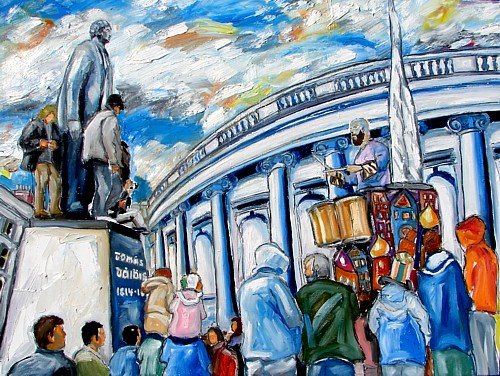
Mór Radharc


'Young Ireland' vs Old Ireland by Caoimhghin Ó Croidheáin (see http://gaelart.net/)

He who fancies some intrinsic objection to our nationality to lie in the co-existence of two languages, three or four great sects, and a dozen different races in Ireland, will learn that in Hungary, Switzerland, Belgium, and America, different languages, creeds, and races flourish kindly side by side…
Thomas Davis.


Is bréag mór é gur choir go mbeadh náisiúnachas in aghaidh an ilchultúrachais. Síolraíonn an claontuairim sin don chuid is mó ó stair nua aimseartha na hEorpha agus an legáid de Nazional Sozialismus sa Gearmáin agus Nationalismo san Iodáil agus, an cineál ‘Fascismo’ a bhí i réim in Éireann gach re seal suas go dtí na seascaidí. Sa chathair ilchultúrtha, ilteangach darb ainm Baile Áth Cliath, feictear fear ag amharc aníos ó Fhaiche Choláiste i lár na cathrach, a bhí duine de na saoithe ba nua-aimseartha agus ba intleacthúla in Éireann dá linne, agus ba ainm do Thomas Davis. Protastúnach, réabhlóideach, file, uomo universale ba ea é agus de bhunaigh sé an páipéar ‘ The Nation’ i 1840. Ag an am, bhí an páipéar sin fíor-choitianta ar fud fad na tíre agus do thug sé léagas intleachúil agus cultúrtha chomh maith le dóchas polaitúil agus sóisialach do mhuintir na tíre. Bhí dearcadh leathan Eorpach ag Davis agus a chomhráidithe agus bhí sé mar intinn aige fuinneamh na tíre a mhúscailt agus cultúr nua-aimseartha a chruthú ó scartha den oidhreacht náisiúnta agus Éireann a chur ar ais i gcróilár de chultúir na hEorpa.

Ach i ré an Davis agus a leithéid bhí ciall agus fealsúnacht ag baint le gluaiseachtaí phobail, gluaiseachtaí chultúrtha. Sa lá atá inniu ann tá níos mó ‘spectacle’ ná ciall, níos mó ghlóir ná ceol. O thosaigh ‘Macnas’ ag sionsáil ar son na hÉireann breis is deich mblian o shin, is féidir linn iad a chloisteáil go minic ach níl morán le cloisteáil, faraor! Céard a cheapfadh Davis de sin? An mbeadh sé dearfach faoi threo cultúrtha na hÉireann?

Níl mé a rá nach bhfuil aon mhaitheas le sionsáil. Is cuimhin liom nuair a bhí mé ag teacht ar ais go hÉireann san Aerfort Charles de Gaulle I bPáras. Bhí oibrithe ag dul thart le drummaí agus bhí an glóir dofhulaingeach. Ba inimircigh formhór acu agus diúltaigh siad na leithris a ghlanadh. Sa chas sin, chur siad in iúl dúinn go han éifeachtach go raibheamar go léir ag brath orthu agus, ní raibheamar in ann a shéanadh go bhfuil an streachailt aicme fós beo. Bhí ciall agus cuspóir an-éifeachtúil ag baint leis seachas sionsáil páisteach dochríochnaithe.

bréag mór- big lie
ilchultúrachas- multiculturalism
claontuairim- prejudice
ilteangach-multilingual
nua-aimseartha-modern
fíor-choitianta- extremely popular
dearcadh- perspective
dearfach-positive
sionsáil.-drumming
inimircigh- immigrants

Sunday, April 01, 2007

Brigit: an Indo-European goddess lost in a Christian desert


Upon its arrival in Ireland, Christianity had to reckon, not only with the warriors, but also with the most powerful female religious figure in all of Irish history: Brigit, a figure who achieved the distinction of becoming a Triple Goddess, a Virgin Mother, a Lawmaker, a Virgin Saint, and finally, a folk image whose shadows still move over Ireland.
Mary Condren, The Serpent and the Goddess p55.

When I was a child in primary school we would gather reeds on the first day of February to make St Brigit crosses. It was an activity which demanded enough dexterity and craft to appeal to the restless mind of a child. We were told that Brigit was a saint. I understood this to mean that she was a real being who could perform magic, good magic or what the Roman Church referred to as ‘miracles’. She was, we were told, a nun, the pagan daughter of an Irish king who converted to Christianity through her association with our ubiquitously revered Patron Saint Patrick. But our education in Irish culture was poor as the inculcation of a ‘Catholic Ethos’ was seen as more important that the exploration of one of Europe’s most ancient mythologies. It was always made clear to us that Patrick was the ‘main man’ was it were, and that Brigit was to be understood as an important though ancillary figure in Irish ecclesiastical history. Of course, the celebration of Brigit as a saint is a distortion of her origin and possible significance for world cultures.

Many of you will be familiar with the words ‘brigade’ and ‘briggant’ the latter denoting a warrior, a former a group of warriors. The word is also common in the Romance languages. ‘Brigantia’ in Latin came to signify ‘strife’. The Gaelic etymology of her name signifes ‘high’ or ‘exalted’ one. But Cormaic in his ancient dictionary derives it from breo-saigit, a fiery arrow. This would account for her association with fire but other etymologists connect it with the Indo-European root ‘bhregh’ meaning ‘swelling, increase, high’ The nuns of the convent in Kildare associated with Brigit continued to light fires in her honour before Pope Adrian IV ordered the Norman invasion in the 12th century.
Brigit was around long before the rise of Christianity. The Celtic genesis myth tells us that in the beginning there was darkness and primeval chaos. Out if this darkness, there arose the waters of the goddess Danu. Danu gave life to an oak tree named Bíle. Two acorns fell from this tree forming Dagda, the Good One and Brigit, the Exalted One. Brigit became the embodiment of the mother goddess Danu and it was she who sent her children to the land where the western sun sets, Inisfáil or the isle of destiny ie Ireland. Brigit is an Indo-European fertility goddess related to other goddesses such as Minerva, Juno, and Isis. She gave her name to the county Kildare, which means the Church of the Oak.

It is clear that the ecclesiastical scholars who wrote about Brigit tried to ignore her Indo European origins. This was simply the attempt by a new patriarchal religion to gain control over the potentially chaotic forces of nature. Henceforth, Brigit, the Mother Goddess, Brigit the warrior would become a passive and docile nun subservient to the will of the masculine church. Many of the stories about Brigit were expurgated from the Christian versions, such as when she made a woman’s foetus disappear. Another story recounts how a man came to her complaining about his wife’s frigidity. Brigit’s cure was so effective that ‘the wife gave exceeding love to him, so that she could not keep apart from him, even on one side of the house; but she was always at one of his hands’. She did hold high esteem in the Celtic Christian Church however, where it is said that she even became a bishop, though this was subsequently played down for obvious reasons. Now that the ideology of Patrick’s church has become more of an historical phenomenon than a contemporary one, the gods and goddesses of Irish mythology may offer us invaluable insights into the ways in which man has related to the earth and to himself in the form of imagined deities. In terms of her dynamic, immanent and multi-faceted nature, Brigit towers over St Patrick and it is a shame that 1st of February is not celebrated as the national day. For it was Brigit who told the Tuatha de Danaan, children of Danu to head for inisfáil, the isle of destiny, Ireland. and the Tuatha de Danann are a potent reminder to us all that Ireland is founded on immigration. She herself lies scattered throughout world cultures, a truly multi-cultural multi-ethnic symbol of human imagination. St Brigit’s Day or Lá Fhéile Bhríde in Irish, was known as Imbolc in pre-christian Ireland. Imbolc means ‘in belly’ and refers to the fertility of mother earth in spring. As the global womb now swells warmer each year, perhaps Brigit, as the ‘fiery arrow’ of human activity, may yet reveal her meaning to us. But by then, of course, we will have returned to darkness.

Téamh domhanda agus comhchruinneán beatha traochta


Humans on the Earth behave in some ways like a pathogenic organism or like the cells of a tumor or neoplasm. We have grown in numbers and disturbance to Gaia, to the point where our presence is perceptibly disturbing….the human species is now so numerous as to constitute a serious planetary malady. Gaia is suffering from Disseminated Primatemaia, a plague of people.’ James Lovelock


'....die vollends aufgeklaerte Erde strahlt im Zeichen triumphalen Unheils' Adorno/Horkheimer

Le blianta fada dúradh go raibh téamh domhanda ag tarlú ach níor thugadar morán aire do.D’athródh an domhan beaganín ach dealraigh sé nach raibh cúis a bheith imníoch. Bhí sé de nós ag alán daoine fonóid a dhéanamh faoin gComhaontas Glas agus trodairí timpeallachta eile agus iad i mbun feachtais chun ár meabhraíocht a ardú fá dtaobh de. Is léir anois go bhfuil cursaí i bhfad níos measa ná shíleamar deich mbliain ó shin. I bhfírinne, tá sé truabhéalach go bhfuilimid ag iarraidh srian a chur ar an bpróiseas anois agus léiríonn sé cé chomh diongbháilte is a táimid chun ár mhaireann ar an mbith a shábháil. Ní féidir a shéanadh a thuilleadh go bhfuil géarchéim phráinneach i gceist anseo, agus is ceann de na teamaí é atá ag cur eagla ar na Stáit Aontaithe anois, tír atá ag fullaingt arís ó tornadaí agus stoirmeacha millteanacha.


Ach an bhfuil sé ró-dhéanach anois chun an damáiste a laghdú? Tá saineaolaithe fós á rá go féidir linn an phróiseas a athrú chun cobhsaíocht aimsire a chur i bhfeidhm. Go deimhin, beidh alán impleachtaí taidhleorachta, eacnamaíochta agus polaitiúila i gceist anseo. Conas a chuirfidh siad in iúl do na tíortha neamhfhorbartha a bhfuil ag brath ar ola chun a ngeilleagar a fhorbairt, go gcaithfidh siad bealaí eile a aimsiú?


Nuair a fhéachann tú ar chás na Braisíle, tá sé follasach ó fada an lá nach bhfuil an rialtas ag coinnéal srian orthu siúd atá ag leanúint ar aghaidh le defhoraisiú os rud é go bhfuil daoine fós in san rialtas a dhéanann brabús as na tairgí soy bean sa reígún. Beidh i bhfad níos mó brú á chur ar tíortha mar sin as seo amach agus beidh athruithe suntasacha de dhíth ar fud an domhain.
Ach an rud nádúrtha é go bhfuil a leithéid ag tarlú? Os rud é go bhfuil daonra domhanda ag fás an t-am ar fad, d’fheadfadh a áiteamh nach bhfuil i gceist anseo ach céim eile san éabhlóid an duine daonna. Tá homo rapiens ag éirí ró-mhór don domhan. Sa chaoi sin d’fheadfá a rá go bhfuil sé nádúrtha go leor. Tá an iomarca daoine ar an domhan agus déanann an duine daonna níos mó dochar don bplainéid ná aon aimhní eile.


Ar ndóigh, brisfidh cogaí agus gorta amach de bharr easpa achmhainne chomh maith. Agus b’fhéidir nach mhairfidh gach sibhialtacht nua i bhfhad a thogadh le déanaí de bharr brabúis ola, cathracha cosúil le Dubaí mar shampla. Ach is féidir an fhadhb a fhéiceáil go soléir má fhéachann muid ar na staitisticí daonna amháin. Fiú ma ghlacann muid go mbeidh laghdú breithe as seo amach de bharr ghnéithe sóisialacha agus méadú de ráta báis mar gheall ar ghorta, bhreoiteacht agus chinedhíothú, ardóidh daonra de 6 millúin duine go dtí 7 nó 8 million i mbliain 2050. I lár na fichiú haoise scríobh na fealsaí gearmánacha Theodor Adorno agus Max Horkheimer ina leabhar cáiliúil darb ainm ‘ Dialectik der Aufklaerung’,

seit je hat Auflaerung im umfassendsten Sinn fortschreitenden Denkens das Ziel verfolgt, von den Menschen die Furcht zu nehmen und sie als Herren einzusetzen.Aber die vollends aufgeklaerte Erde strahlt im Zeichen triumphalen Unheils

‘Ba ea an aidhm a bhí ag léargas de shíoraí sa chaill is coitinne de smaointeachas forbatha, ná fáil réidh le heagla agus an duine a chur dul chun cinn mar mháistir. Ach is léir go bhfuil an domhan léirithe go hiomlán ag taispéaint comharthaí caithréimeacha de thubaiste.’

Bheadh sé doiligh argóint a dhéanamh anois ar son leargais toisc go bhfuil an chinéal réasúin sin fons et origo de thubaiste ollmhór atá ag tarlú timpeall orainn. Tá na saineolaithe ag maíomh go féidir linn stop a chur ar theas domhanda más thig linn symbiosis cobhsaíoch a chothú sa chomhchruinneán beatha, ach ní éireoidh muid a leithéid a chur i gcrích muna n-athrófar inneal an domhain, caipitleachas liobrálach. Ach faraor, níl sé sin ag tarlú.
Gluais
Meabhraíocht- consciousness
Truabhéalach- pathetic
Géarchéim- crisis
Diongbháilte- determined
Brabús- profit
Saineolaithe- experts
chomhchruinneán beatha- biosphere.
Tubaiste- catastrophe