Tuesday, April 03, 2007

Mór Radharc


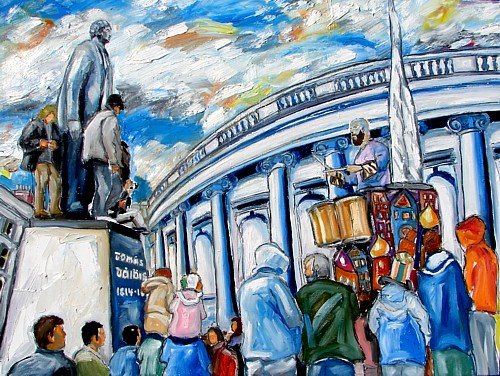
'Young Ireland' vs Old Ireland by Caoimhghin Ó Croidheáin (see http://gaelart.net/)

He who fancies some intrinsic objection to our nationality to lie in the co-existence of two languages, three or four great sects, and a dozen different races in Ireland, will learn that in Hungary, Switzerland, Belgium, and America, different languages, creeds, and races flourish kindly side by side…
Thomas Davis.


Is bréag mór é gur choir go mbeadh náisiúnachas in aghaidh an ilchultúrachais. Síolraíonn an claontuairim sin don chuid is mó ó stair nua aimseartha na hEorpha agus an legáid de Nazional Sozialismus sa Gearmáin agus Nationalismo san Iodáil agus, an cineál ‘Fascismo’ a bhí i réim in Éireann gach re seal suas go dtí na seascaidí. Sa chathair ilchultúrtha, ilteangach darb ainm Baile Áth Cliath, feictear fear ag amharc aníos ó Fhaiche Choláiste i lár na cathrach, a bhí duine de na saoithe ba nua-aimseartha agus ba intleacthúla in Éireann dá linne, agus ba ainm do Thomas Davis. Protastúnach, réabhlóideach, file, uomo universale ba ea é agus de bhunaigh sé an páipéar ‘ The Nation’ i 1840. Ag an am, bhí an páipéar sin fíor-choitianta ar fud fad na tíre agus do thug sé léagas intleachúil agus cultúrtha chomh maith le dóchas polaitúil agus sóisialach do mhuintir na tíre. Bhí dearcadh leathan Eorpach ag Davis agus a chomhráidithe agus bhí sé mar intinn aige fuinneamh na tíre a mhúscailt agus cultúr nua-aimseartha a chruthú ó scartha den oidhreacht náisiúnta agus Éireann a chur ar ais i gcróilár de chultúir na hEorpa.

Ach i ré an Davis agus a leithéid bhí ciall agus fealsúnacht ag baint le gluaiseachtaí phobail, gluaiseachtaí chultúrtha. Sa lá atá inniu ann tá níos mó ‘spectacle’ ná ciall, níos mó ghlóir ná ceol. O thosaigh ‘Macnas’ ag sionsáil ar son na hÉireann breis is deich mblian o shin, is féidir linn iad a chloisteáil go minic ach níl morán le cloisteáil, faraor! Céard a cheapfadh Davis de sin? An mbeadh sé dearfach faoi threo cultúrtha na hÉireann?

Níl mé a rá nach bhfuil aon mhaitheas le sionsáil. Is cuimhin liom nuair a bhí mé ag teacht ar ais go hÉireann san Aerfort Charles de Gaulle I bPáras. Bhí oibrithe ag dul thart le drummaí agus bhí an glóir dofhulaingeach. Ba inimircigh formhór acu agus diúltaigh siad na leithris a ghlanadh. Sa chas sin, chur siad in iúl dúinn go han éifeachtach go raibheamar go léir ag brath orthu agus, ní raibheamar in ann a shéanadh go bhfuil an streachailt aicme fós beo. Bhí ciall agus cuspóir an-éifeachtúil ag baint leis seachas sionsáil páisteach dochríochnaithe.

bréag mór- big lie
ilchultúrachas- multiculturalism
claontuairim- prejudice
ilteangach-multilingual
nua-aimseartha-modern
fíor-choitianta- extremely popular
dearcadh- perspective
dearfach-positive
sionsáil.-drumming
inimircigh- immigrants

Sunday, April 01, 2007

Brigit: an Indo-European goddess lost in a Christian desert


Upon its arrival in Ireland, Christianity had to reckon, not only with the warriors, but also with the most powerful female religious figure in all of Irish history: Brigit, a figure who achieved the distinction of becoming a Triple Goddess, a Virgin Mother, a Lawmaker, a Virgin Saint, and finally, a folk image whose shadows still move over Ireland.
Mary Condren, The Serpent and the Goddess p55.

When I was a child in primary school we would gather reeds on the first day of February to make St Brigit crosses. It was an activity which demanded enough dexterity and craft to appeal to the restless mind of a child. We were told that Brigit was a saint. I understood this to mean that she was a real being who could perform magic, good magic or what the Roman Church referred to as ‘miracles’. She was, we were told, a nun, the pagan daughter of an Irish king who converted to Christianity through her association with our ubiquitously revered Patron Saint Patrick. But our education in Irish culture was poor as the inculcation of a ‘Catholic Ethos’ was seen as more important that the exploration of one of Europe’s most ancient mythologies. It was always made clear to us that Patrick was the ‘main man’ was it were, and that Brigit was to be understood as an important though ancillary figure in Irish ecclesiastical history. Of course, the celebration of Brigit as a saint is a distortion of her origin and possible significance for world cultures.

Many of you will be familiar with the words ‘brigade’ and ‘briggant’ the latter denoting a warrior, a former a group of warriors. The word is also common in the Romance languages. ‘Brigantia’ in Latin came to signify ‘strife’. The Gaelic etymology of her name signifes ‘high’ or ‘exalted’ one. But Cormaic in his ancient dictionary derives it from breo-saigit, a fiery arrow. This would account for her association with fire but other etymologists connect it with the Indo-European root ‘bhregh’ meaning ‘swelling, increase, high’ The nuns of the convent in Kildare associated with Brigit continued to light fires in her honour before Pope Adrian IV ordered the Norman invasion in the 12th century.
Brigit was around long before the rise of Christianity. The Celtic genesis myth tells us that in the beginning there was darkness and primeval chaos. Out if this darkness, there arose the waters of the goddess Danu. Danu gave life to an oak tree named Bíle. Two acorns fell from this tree forming Dagda, the Good One and Brigit, the Exalted One. Brigit became the embodiment of the mother goddess Danu and it was she who sent her children to the land where the western sun sets, Inisfáil or the isle of destiny ie Ireland. Brigit is an Indo-European fertility goddess related to other goddesses such as Minerva, Juno, and Isis. She gave her name to the county Kildare, which means the Church of the Oak.

It is clear that the ecclesiastical scholars who wrote about Brigit tried to ignore her Indo European origins. This was simply the attempt by a new patriarchal religion to gain control over the potentially chaotic forces of nature. Henceforth, Brigit, the Mother Goddess, Brigit the warrior would become a passive and docile nun subservient to the will of the masculine church. Many of the stories about Brigit were expurgated from the Christian versions, such as when she made a woman’s foetus disappear. Another story recounts how a man came to her complaining about his wife’s frigidity. Brigit’s cure was so effective that ‘the wife gave exceeding love to him, so that she could not keep apart from him, even on one side of the house; but she was always at one of his hands’. She did hold high esteem in the Celtic Christian Church however, where it is said that she even became a bishop, though this was subsequently played down for obvious reasons. Now that the ideology of Patrick’s church has become more of an historical phenomenon than a contemporary one, the gods and goddesses of Irish mythology may offer us invaluable insights into the ways in which man has related to the earth and to himself in the form of imagined deities. In terms of her dynamic, immanent and multi-faceted nature, Brigit towers over St Patrick and it is a shame that 1st of February is not celebrated as the national day. For it was Brigit who told the Tuatha de Danaan, children of Danu to head for inisfáil, the isle of destiny, Ireland. and the Tuatha de Danann are a potent reminder to us all that Ireland is founded on immigration. She herself lies scattered throughout world cultures, a truly multi-cultural multi-ethnic symbol of human imagination. St Brigit’s Day or Lá Fhéile Bhríde in Irish, was known as Imbolc in pre-christian Ireland. Imbolc means ‘in belly’ and refers to the fertility of mother earth in spring. As the global womb now swells warmer each year, perhaps Brigit, as the ‘fiery arrow’ of human activity, may yet reveal her meaning to us. But by then, of course, we will have returned to darkness.

Téamh domhanda agus comhchruinneán beatha traochta


Humans on the Earth behave in some ways like a pathogenic organism or like the cells of a tumor or neoplasm. We have grown in numbers and disturbance to Gaia, to the point where our presence is perceptibly disturbing….the human species is now so numerous as to constitute a serious planetary malady. Gaia is suffering from Disseminated Primatemaia, a plague of people.’ James Lovelock


'....die vollends aufgeklaerte Erde strahlt im Zeichen triumphalen Unheils' Adorno/Horkheimer

Le blianta fada dúradh go raibh téamh domhanda ag tarlú ach níor thugadar morán aire do.D’athródh an domhan beaganín ach dealraigh sé nach raibh cúis a bheith imníoch. Bhí sé de nós ag alán daoine fonóid a dhéanamh faoin gComhaontas Glas agus trodairí timpeallachta eile agus iad i mbun feachtais chun ár meabhraíocht a ardú fá dtaobh de. Is léir anois go bhfuil cursaí i bhfad níos measa ná shíleamar deich mbliain ó shin. I bhfírinne, tá sé truabhéalach go bhfuilimid ag iarraidh srian a chur ar an bpróiseas anois agus léiríonn sé cé chomh diongbháilte is a táimid chun ár mhaireann ar an mbith a shábháil. Ní féidir a shéanadh a thuilleadh go bhfuil géarchéim phráinneach i gceist anseo, agus is ceann de na teamaí é atá ag cur eagla ar na Stáit Aontaithe anois, tír atá ag fullaingt arís ó tornadaí agus stoirmeacha millteanacha.


Ach an bhfuil sé ró-dhéanach anois chun an damáiste a laghdú? Tá saineaolaithe fós á rá go féidir linn an phróiseas a athrú chun cobhsaíocht aimsire a chur i bhfeidhm. Go deimhin, beidh alán impleachtaí taidhleorachta, eacnamaíochta agus polaitiúila i gceist anseo. Conas a chuirfidh siad in iúl do na tíortha neamhfhorbartha a bhfuil ag brath ar ola chun a ngeilleagar a fhorbairt, go gcaithfidh siad bealaí eile a aimsiú?


Nuair a fhéachann tú ar chás na Braisíle, tá sé follasach ó fada an lá nach bhfuil an rialtas ag coinnéal srian orthu siúd atá ag leanúint ar aghaidh le defhoraisiú os rud é go bhfuil daoine fós in san rialtas a dhéanann brabús as na tairgí soy bean sa reígún. Beidh i bhfad níos mó brú á chur ar tíortha mar sin as seo amach agus beidh athruithe suntasacha de dhíth ar fud an domhain.
Ach an rud nádúrtha é go bhfuil a leithéid ag tarlú? Os rud é go bhfuil daonra domhanda ag fás an t-am ar fad, d’fheadfadh a áiteamh nach bhfuil i gceist anseo ach céim eile san éabhlóid an duine daonna. Tá homo rapiens ag éirí ró-mhór don domhan. Sa chaoi sin d’fheadfá a rá go bhfuil sé nádúrtha go leor. Tá an iomarca daoine ar an domhan agus déanann an duine daonna níos mó dochar don bplainéid ná aon aimhní eile.


Ar ndóigh, brisfidh cogaí agus gorta amach de bharr easpa achmhainne chomh maith. Agus b’fhéidir nach mhairfidh gach sibhialtacht nua i bhfhad a thogadh le déanaí de bharr brabúis ola, cathracha cosúil le Dubaí mar shampla. Ach is féidir an fhadhb a fhéiceáil go soléir má fhéachann muid ar na staitisticí daonna amháin. Fiú ma ghlacann muid go mbeidh laghdú breithe as seo amach de bharr ghnéithe sóisialacha agus méadú de ráta báis mar gheall ar ghorta, bhreoiteacht agus chinedhíothú, ardóidh daonra de 6 millúin duine go dtí 7 nó 8 million i mbliain 2050. I lár na fichiú haoise scríobh na fealsaí gearmánacha Theodor Adorno agus Max Horkheimer ina leabhar cáiliúil darb ainm ‘ Dialectik der Aufklaerung’,

seit je hat Auflaerung im umfassendsten Sinn fortschreitenden Denkens das Ziel verfolgt, von den Menschen die Furcht zu nehmen und sie als Herren einzusetzen.Aber die vollends aufgeklaerte Erde strahlt im Zeichen triumphalen Unheils

‘Ba ea an aidhm a bhí ag léargas de shíoraí sa chaill is coitinne de smaointeachas forbatha, ná fáil réidh le heagla agus an duine a chur dul chun cinn mar mháistir. Ach is léir go bhfuil an domhan léirithe go hiomlán ag taispéaint comharthaí caithréimeacha de thubaiste.’

Bheadh sé doiligh argóint a dhéanamh anois ar son leargais toisc go bhfuil an chinéal réasúin sin fons et origo de thubaiste ollmhór atá ag tarlú timpeall orainn. Tá na saineolaithe ag maíomh go féidir linn stop a chur ar theas domhanda más thig linn symbiosis cobhsaíoch a chothú sa chomhchruinneán beatha, ach ní éireoidh muid a leithéid a chur i gcrích muna n-athrófar inneal an domhain, caipitleachas liobrálach. Ach faraor, níl sé sin ag tarlú.
Gluais
Meabhraíocht- consciousness
Truabhéalach- pathetic
Géarchéim- crisis
Diongbháilte- determined
Brabús- profit
Saineolaithe- experts
chomhchruinneán beatha- biosphere.
Tubaiste- catastrophe

In search of the Leprechaun

How strange it is that so many people all over the world are familiar with the figure of the leprechaun. It has become the most effete cliché in our vacuous tourist industry. Yet very few people know what it means, where the word comes from. I got a call from a friend in Talinn recently who was entertaining Estonian friends. They said they were familiar with the leprechaun. My friend who is Irish wanted to check the origin of this myth with me, so I explained the origin to him again. Leprechaun comes from the Irish Lugh an Lamh fhada, Lugh of the long hand, who was the god of light and wisdom. In Irish mythology, Lugh defeats the evil warrior called Balor of the Evil Eye in the internecine battle that would become known as Cath Magh Tuireadh, or the Battle of Moytura. In this battle the forces of good represented by the Tuatha De Danann, the children of the goddess Danu, (an Indo-European figure originating in India and flowing through Europe in the form of the Danube), and the Fomorii, those who dwell ‘fo mhuir’ beneath the sea, the forces of evil who were led by Balor. Balor’s evil eye destroyed everything it looked upon. Lugh kills Balor with a sling which gouges out his enormous eye. When the battle is over, however, Domnu the nefarious Doppelgeist of Danu, utters the following admonishment to Danu

‘all life is transitory. Even your children are not immortal, my sister. The time will come when they will be defeated. The time will come when no one will want gods and goddesses to nurture them, when they will be driven into the darkness, like my children have been this day’

The words Reich in German, Rí in Irish and Raj in Hindi are cognate with the English word ‘reach’. Rí is the Irish for King. One’s kingdom was one’s reach, that which one held. Reich in German means exactly this. The verb ‘ereichen’ means to reach or attain. Lugh was one of the most revered gods in Irish mythology. He was the father of Cúchulainn and gave his name to places as diverse as Ireland’s smallest county, County Louth and Lyon in France, both derived from Lugdunum, or the fort of Lug. His feast is still in August which is Lughnasa in Irish. In the Middles Ages, the notion of a pagan God commanding so much power and respect was anathema to the zealous monks who were transcribing the myths. So they changed his name to Lugh Chromain, little stooping Lugh. Through corruption this became the ridiculous Leprechaun. What this case shows is that cultural symbols can become caricatures of themselves through the changing ideologies of history.

RTE Féile Cheoil bheo. Harmonienlehre sa Cheoláras Náisiúnta.

Bhuail mé an bóthair le diograis aréir. Bhí mé ar mó bhealach go Baile Átha Cliath chun freastal ar an gceolchoirm sa Cheoláras Náisiúnta de John Adams, duine de na mór-chumadóirí na linne. Ach le meascán de bhrú an tsaoil, agus siléig ba chóir a adhmháil, níor shroich mé lár na cathrach go dtí 8 a chloig. Ba mhór agus géarchúiseach mó dhíomá is mé ag iarraidh mó ghluaisteán a locadh agus Bernhad Clarke, an díograiseoir par excellence i ndomhan ceoil ag tosnú an cheolchoirm a chraoladh beo ar Lyric FM. D’fhan mé cúpla nóiméad agus bhí me curtha faoi dhraíocht ón gcéad nóta de chuid a shaothar Lollapollousa. Ní raibh mé ró-eolasach faoin gceol siúd roimhe sin seachas corshliocht a cloisfinn ó am go chéile sa chlár Nova I Lyric FM. D’oscail sé le dráma agus fuinneamh agus bhí sé soléir go rachfainn i bhfad siar i mó shamhlaíocht agus chéadfa dá n-éistfinn leis go deireadh. Ach le turas fada i mo dhiaidh is mé cúpla kiloméadar ón gCeoláras le déanamh, chinn mé ar iarracht a dhéanamh ar a laghad chun teacht isteach ar chúl.

Bhí an t-ádh liom agus mé ag teacht isteach ar an príomhdhoras an fhoirgnimh.Shúil mé díreach chuig an fháilteoir. ‘ An bhfuil ticéad curtha in áirithe agat a dhuine uaisle’ a deir sí ‘níl’, deirim,’ ach is dócha go bhfuil ticéad ar mo chara istigh dom’. D’fhéach sí go neamhchúiseach orm agus thug sí ticéad dom saor in aisce cé nach raibh m’ainm ar aon liosta. Bhí an píosa fós ar siúl nuair a fuair me mó shuíochán ar chúl na hamharclainne ach d’éisc mé go hiomlán lena dara chuid darb ainm Harmonienlehre. Is tagairt do Arnold Schoenberg é an saothar seo inar ndéanann Adams iarracht an lámh in uachtar a fháil ar Schoenberg le cinéal harmonia a chruthú lena theanga cheoil thagarthach féin. Ba ea ‘minimalism’ an t-ainm a thugtar ar an gceol de chuid Adams cosúil le Philip Glass Steve Reich, ach i bhfírinne, tá a cheol i bhfad níos suimúila ná a chomhghleacaithe súid. Agus sa Harmonienlehre taispeáineann Adams cen fáth nach dtaitníonn na nótaí lom míbhinn de Schoenberg le mórchuid na n-éisteoirí. Éiríonn leis chomh maith, an ‘Lehre’ a thabhairt do Schoeberg faoi chumadóireacht. Cruthaíonn Adams téagar ilshraitheach lán de hathruithe túin agus éiríonn leis bríomhaireacht a fháil a chuireann Mahler agus Wagner in iúl ina mhothúcháin agus Stravinsky sa chaoi inar gcruthaíonn sé teannas agus claochchlú fuaime. Léiríonn sé sa phíosa seo chomh maith nach bhfuil ‘minimalism’ cúi don chinéal ceoil atá i gceist anseo. Fuair Adams inspioráid don chéad ghluaiseacht sa bhroinglóid inár shamhlaigh sé gluaisteán ag teacht aniar ón bhfarraige de chuan San Francisco go dtí an spéir. Ta tagairtí do Parsifal de Wagner chomh maith agus tá an ceol tagarthach agus lán de bhríomhaireacht shaibhir an t-am ar fad. Críochnaíonn an saothar leis an ngluaiseacht darb ainm ‘Meister Eckhardt and the Quackie’ agus tagann na nótaí éagsúla go dtí pointe lárnach ag dul timpeall an eochair E Mín. Níl aon focail eile don saothar seo ach magnum opus agus ba ocáid speisíalta í seo a d’fhanfaidh I bhfad I mo chuimhne agus toisc go bhfuil airgead fágtha dom, beidh oíche eile san Cheoláras Náisiúnta sar i bhfad.

Seachtain na Gaeilge, Irish week

This week is seachtain na Gaeilge, Irish week. For many of you, this will come as a surprise.Most of you are unlikely to have heard much of the language spoken in the cafés, pubs and shops of Ireland’s busy thoroughfares.Even though there are many events on all over the country, sometimes it feels as though the language exists in a sort of a parallel universe, irretrievably lost in the ether of our nation’s collective unconscious, surfacing furtively every now and then by deftly disguising itself as English. Even though the language is written all around us, it requires an effort to actually perceive it. In a sense, the notion of a bilingual place name is somewhat perplexing. A place should have a name. That is all. When we provide anglicized versions next to the names we are immediately negating the possibility of linguistic consciousness being awakened every time we utter that place name. We pronounce its meaningless English version. This not only distorts the word but it deprives that place name of dignity. A place with the dignified name of An Obair meaning, The Work, mutates into the meaningless and ignoble ‘Nobber’. An Uaimh meaning The Cave, becomes the insipid sounding Naven. Most place names thoughout the country contain some sort of meaning yet most people are unaware of this. It is often argued that foreign nationals would not understand or be able to read the place names if they were only in Irish, but this is nonsense. English literacy is one of the most irregular and illogical in the Indo-European language group. Why would Gallimh be any harder for a Polish person to pronounce than Galway? Should the French anglicize their place names so that foreigners will be able to understand them better? Of course not. The French are far too proud of their national language, and besides, the absurdity of the suggestion would soon be ridiculed. If monolingual placenames were introduced, it would not only raise our own awareness of the language but that of visitors to Ireland, most of whom are interested in the country’s language and culture. It would also bring us closer to the language in our daily lives, making the cúpla focail an effortless daily phenomenon. Everyone educated in Ireland has some smattering of the language. Yet one rarely hears ‘dia dhuit’ or go raibh maith agat or slán. Why? I suppose it is not natural for a predominantly monolingual society to consciously introduce the words and expressions of another language into common speech. Yet, what about the role of the state, what about the public sector? Public sector? Did I not see that advertised in the January sales? One of the difficulties with the state project of linguistic regeneration is the diminution of the very state itself. Privatisation of public services has made it increasingly difficult to implement policies that are not motivated by the formula of profit and loss. Yet, the attitude of the public bodies to the language is still lax and uncommitted. It is a requirement that all workers in public libraries, the Garda Síochána, county councils, have a sufficient command of Irish to be able to do their business through that medium. The problem here is lip-service without speech. Why am I not greeted by ‘dia dhuit’ when I am accosted by a Garda, or when I go to get a book out from the library, or when I ring up the county council looking for information? Why can’t we have a situation where I am not embarrassed and self-conscious for speaking Irish? The cúpla focail are not difficult. Yet, why is it not part of the training and practice of public bodies to reflect the aspirations of the constitution of the state? Why will debates in Dáil Éireann and the Seanad be conducted in English this week? The state policy allows for the potentiality of Irish instead of its actuality. In other words, if I ring up the county council and I am greeted with ‘hello, how can I help you?’changing the language to Irish involves a conscious effort on my behalf becoming an object of communication rather than a means.If the bilingual legislation were implemented it would revolutionize Irish culture introducing colour and grace into the banalities of everyday communication, bringing the language out of the night and back to where it belongs in the cold light of day. Whether we like it or not, the spectre of Irish has not gone away you know. As long as we the multi-ethnic people of this island call ourselves Irish, the language question will remain inextricably linked to our sense of identity.

Dialann na hainnise

On entre, on crie, c’est la vie,
on crie on sort, c’est la mort’
Racine


Tá mó tríocha bliain ag teannadh liom. Ó shroich mé fichiu is a haon bliain d’aois níor theastainn uaim aon cheilúradh a dhéanamh ar mó bhreithlá. Ba scéal eile é nuair a bhí mé i luisne na hóige is mé ag tnúth leis an tsaoirse a bhainfinn as a bheith níos sine. Ach níl aon chúis a bheith dearfach faoin athrú ama. Tagann an saol, tagann an bás; idir an dá linn tá a lán streachailt agus fulaingt le cur suas leis sular dtéimid ar shlí na fírinne. Sin sin. Nílim a rá nach bhfuil suairceas ar bith ann. Faigheann muid suairceas mar shampla, nuair a dhéanaimid chomhriachtain don nóiméad beag bídeach, b’fhéidir, nó ag éisteacht le ceol cumhachtach drámatúil cosúil le Wagner nó Mahler, más féidir linn ‘suairceas’ a thabhairt ar an gcinéal soláis a fhaigheann muid as Liebestod nó Das Klagande Leid!

Nach mbeadh an bréag a dheireann beagnach gach sagart de gach reiligúin agus a thugann siad ‘flaitheas’ air, nach mbeadh sé sin cosúil le bheith ag bualadh craiceann le Kyle Minogue , ag togáil coicain is ag éisteacht le Ride of the ‘ValKylies’ ag an am céanna don chéad uair? Agus mhairfeadh sé de shíoraí de shíoraí! De de de dah dah de de de dah dah de de de daaaaaaaaaaah! Ní bheadh aon post-coitus, nó aon adagio níos mó, just súnas síoraíoch, allegro fortissimo! Agus má tá sé cosúil le sin, cén fáth nach gcuireann muid deireadh lenár saol anois agus ar aghaidh linn go dtí na Kylies dár mbrionglóidí! A consumation devoutly to be wished? Ní hea, tiocfaidh an adagio ar ais agus an iarchollaíocht leis!

Ní he go bhfuilim dolásach faoi dheireadh mó hóige, is ró-mhinic a shileann muid go mba am úr shimplí neamhurchóideach í ár n-óige ach nach raibh buairt is sceon is nausea céanna againne ag an am sin nuair a thosaigh muid ag foghlaim faoi na rialacha neamhchiallmhare den domhan mór seo? Cén fáth go shileann muid deor is screadeann muid nuair a bhreitheann muid? When we are born we cry that we are come to this stage of fools arsa Lear an Rí. Cé chomh minic is a chaoineann páistí nuair a thugann siad faoi ndeara nach gclíonn an domhan lena réamhchoincheap, agus cé nach dtugaimid aon luach ar a gcaoineadh neamhchiallmhar súid, tá a bpian chomh scéinúil sin is a bheidh sé i rith a shaol ach le athrú amháin; le himeacht ama beidh siad ábalta réasunú agus beidh an fhulaingt níos mó dá bharr.


Ní mór dom a admháil anseo nach bhfuil aon saíocht nó fealsúnacht bailithe agam go fóill as mó thuras tríd an domhan. Agus tá fhios agam freisin go bhfuilim an eoraip-lárnaithe i mo dhearcadh. B’fhéidir ba chóir dom turas fada a dheánamh anois i bhfad siar ó theorainn na hEorpa. Uaireannta is turas fada an saol, scaití is turas beag é. Ach taisteálann gach duine ina haonar le ticéad aon-bhealach chuig an bás. É sin ráite ní féidir a shéanadh go gcaithfidh muid glacadh go bhféadfadh ár shaol a bheith i bhfad níos measa agus níos measa fós. Muna gcuirim isteach orainn le mó headóchas, tagróidh mé do Shakespeare arís.
Better thus and known to be contem’d,
To be the lowest and most dejected thing of fortune,
Stand still in esperance, lose not in fear
The lamentable change is from the best
The worst returns to laughter.
The wretch that thou has blown unto the worst
Owes nothing to thy blasts.

Ní bheidh aon chóisir agam ar son mó bhreithlá. Beidh faoiseamh éigin agam agus an solás go bhféadfadh gach rud a bheith níos measa. ‘ but whose can say I’m at the worst, I’m worst than ere I was and worse I may be yet, the worst is not so long as we can say “this is the worst”. Agus ar ndóigh ní bheidh muid in ann é sin a rá sular stopann an traein cibé áit cibé am.

The Contradictions of Capitalism


Modern bourgeois society with its relations of production, of exchange and of property,
A society that has conjured up such gigantic means of production and of exchange, is like the sorcerer, who is no longer able to control the powers of the nether world, whom he has called up with his spells
.
Marx and Engels- The Communist Manifesto


As election placards are hoisted throughout the country urging the masses to vote for this or that party’s bogus policies, their own particular tint of the same colour, the spectre of Ireland’s recent industrial past has once again reared its ugly head: unemployment. For a while, it seemed that this problem was a class room matter, something which the insouciant nouveau riche of the Celtic Tiger generation read about when studying economic history. The consensus of the last few years has been that Ireland has become one big happy middle class family. Everyone has money, so it seems. Therefore any talk of real left-right politics is scrupulously circumscribed. However, this year’s political concert rehearsals have been surprised by an unexpected cacophony: unemployment. Could this become an election issue before the curtain is raised in a few months time? The announcement of new job losses in Cork last week came as a shock to those who faithfully imbibed the government’s economic propaganda; ie those who had got married, bought property and booked their two weeks in the sun.


Today’s Ireland is a nation of multinational mobile companies who set up shop when wages are low and abscond when better opportunities arise elsewhere. As Marx and Engels put it
‘The need of a constantly expanding market for its products chases the bourgeoisie over the whole surface of the globe. It must nestle everywhere, settle everywhere, establish connections everywhere.’

It is well known that the most central feature of capitalism is the boom and bust phenomenon. Marx and Engels spoke of ‘ the commercial crises that by their periodical return put on trial, each time more threateningly the very existence of the entire bourgeois society’. For a while now we have heard that the property market, the internal combustion engine of the Irish economy, may be showing signs of slowing down. This is hardly surprising, as those who are building the houses, ie the property developers are renting them out at inflated prices, flagrantly ignoring the needs of the majority of the population.


The whole property market has become a bauble for speculators and millionaires, instead of shelter for the populace. The average couple is forced to work over a 40 hour week to satisfy the lucre-lust of the multinational conglomerates who run this country, and to repay the borrowed money which they need to keep the whole property charade going. With all the stress, fast food and convenience foods become more common with their resultant ill-health, diabetes, depression, heart disease etc, the maladies of the hypercapitalist era. But not to worry, the government provides. That is to say, it provides for those who can pay for everything has its price. It seems the answer to the pathetic joke that calls itself the Health Service Executive is to build more private hospitals where people with money can get top service while the rest of us are consigned to death. After all, privatization has proved to be an astounding success, it’s most outstanding examples being the M50 toll bridge (subsequently bought back by the government at an astronomical price) and Eircom. But fear not, there’s plenty more on the way.


Eircom deserve special mention here. Many of those made redundant who are living in rural parts of Cork will find it harder to look for new jobs as they do not have a broadband internet connection. Ireland has one of the worst records in the developed world for the provision of broadband. We are at the bottom of the European table here, shamelessly traipsing behind countries such as Finland and Estonia. Eircom have recently announced a new initiative to provide an ubiquitous broadband service but such pronouncements have been dogged by procrastination on monetary grounds for years now. Eircom will not connect rural areas as they do not deem it profitable enough to do so. There was a time when Telecom Eireann existed to provide good communication for the state. The aim of the company then was to provide a service for the people. Eircom’s goal now is simply to make a profit. Service has nothing to do with it. The problem here however, is one of pure myopia. If I may allude to Marx and Engels once more
‘constant revolutionizing of production, uninterrupted disturbance of all social conditions, everlasting uncertainty and agitation distinguish the bourgeois epoch from all earlier ones’.
The government by failing to ensure the provision of the internet to every citizen of the state has weakend Ireland’s ability to be a competitor in the global information economy. What we have in the case of Eircom is an example of capitalism being hoist by its own petard, which is of course its very essence.

Sunday, January 28, 2007

Gearóid Ó Colmáin on the Stealth Service Executive.

The Irish political landscape is becoming progressively bleak. Is there any way of getting rid of Fianna Fáil? How should we understand this world ‘fáil’, is it our destiny to have them or their destiny to have us? Are the people who run the worst health service in Europe, the feidhmeanas na seirbhíse sláinte ( the Health Service Executive), those comatose administrators of Hades, to be reinstated again?

There was much ado about the government’s National development plan last week with tonnes of money being flaunted. But it has been clear for a long time that there is a discrepancy between the possession of huge sums of money and the acumen required to convert it into an efficient administration. You are probably taking more of a risk entering some of our hospitals now than a lengthy sojourn in Chernoble! The word hospital in Ireland has come to signify that place you go to get sick! The Swedish word for hospital is ‘sjukhus’, literally ‘sickhouse’ like the German ‘Krankenhaus’. The irony is that these countries have health services that work! Another problem with the Feidhmeanas na Seirbhíse Sláinte is that it is generating so much bad publicity. This too could have serious consequences for our mental health. Have you felt that ineffable sense of despair every time you tuned into Prime Time on RTE recently with its interminable reports of sick people whose condition worsened once they entered the doors of the HSE? Bad news about the health service is making this country ill!

If this shambolic government is re-elected I suggest they change the name of Feidhmeanas na Seirbhíse Sláinte to DSE, The Death Service Executive. They could run a chirpy advertisement campaign which would go along these lines: ‘Are you having trouble dying? Get to your nearest hospital now and we’ll put an end to your misery. With overcrowding in our waiting areas, infectious diseases spreading rapidly and a conspicuous absence of specialists, we’ll have you dead in no time. The DSE, sponsored by Dante’s Inferno Ltd. Abandon all hope ye who enter in!’.

On a more cheerful note, all of this could end. But it should seem obvious to muintir na hÉireann that the Fianna have got to go! So what’s the alternative? Well, seeing as our only true socialist leader James Connoly was shot 90 years ago, and Irish democracy has always been a charade since then between two right wing parties, each trying to right wing the other out of power, our only hope now is in Fine Gael. Yes, Fine Gael, those rural crusaders, those harbingers of , harbingers of something, possibly, maybe? Can we put hope in Fine Gael? This is a silly question as they have no policies, no solutions, no coherent ideology other than questionable beliefs in some form of pan European Christian homogeneity with a celtic gloss. Fine Gael, wasn’t that the party who had a brief fling with that raving catholic fascist Eoin O Duffy in the 1930s? I’m afraid so. But to be fair they’ve calmed down a bit since then. Nowadays, all they are saying is that we should have a debate about immigration, which is code-language for ‘When we get into power we’ll send those effing foreigners home’. Again to be fair, I rather like Enda Kenny and I don’t think he is a xenaphobe. But there are plenty of xenophobes out there who vote for Fine Gael and he knows it. Every vote counts when you’re desperate! Poor Enda, his heart must be broken after Labour’s Pat pulled a Rabbite out of his hat yet again by equivocating about whether he would share power with Fianna Fáil, after telling the electorate that he would never ever do so. Yes, Rabbite was eloquent on Questions and Answers a while back with his pompous ‘’ what part of no don’t you understand?’’ So what part of no. yes/no no/yes, maybe, possibly if and when, don’t we understand? Seeing as Labour and Fine Gael seem to have squandered their chances of ousting Fianna Fáil, one can only hope that An Comhaontas Glas, the Green Party gets into power. Seeing as it is now accepted that the global heat is on and that Noah’s Flood is due for a come back, it might be prudent to vote for the Greens. You would probably still get Fine Gael, but at least you would get Fianna Fáil out. As well as that, we might get a public transport service and a health service that works. Imagine that! The thought of Fianna Fáil getting back into power again is the thought of the Stealth Service Executive, the oil dependent economy, the plutocracy whose motto is ‘don’t get sick if you need a public hospital’. It’s time to take the ‘fáil’ away from the ‘fianna’ and give it back to the people!

Gearóid O Colmáin on The Colonized

‘Every time the question of the language surfaces, in one way or another, it means that a series of other problems are coming to the fore: the formation and enlargement of the governing class, the need to establish more intimate and secure relationships between governing groups and the national-popular mass, in other words to re-organise the cultural hegemony’.

Antonio Gramsci.

This year sees the accession of two new member states to the European Union, Rumania and Bulgaria. Two more languages, two new motifs to the great symphony of European polyglossia (many tongues). 2007 will also be the year in which official documentation of the EU is translated into Irish. It took our governments long enough to insist on the implementation of this legislation, and it shows how far we have matured since our own accession to the euro club in 1973. But just how important is it to have EU documents in Irish? To the common man or woman it is of little consequence. Why then, should so much money be spent producing literature that very few are going to read? It has symbolic importance, but is this good enough? Is it sufficient to awaken this country from its cultural slumber, its socio-linguistic malaise, the trauma of its nebulous past? Will we hear Gaelic spoken in Strasbourg and Brussels? Spoken Gaelic loud and clear.That is all that is required now. Rumours of the language’s death have been greatly exaggerated. In fact, nothing could be further from the truth. Irish language literature is flourishing and our Gaelscoileanna are among the finest in the country. Now is the time for assertion and confidence. We are one of the most rapidly growing multicultural counties in Europe with well over a hundred languages spoken in our schools. We are also a country that has emerged, albeit scared and wounded, from the nightmare of history. Many who have joined us from overseas (dream dár slua thar thoinn tháinig chugainn- some have come from across the wave- Amhráin na bhFiann, national anthem), have experienced colonialism and many speak minority languages.This should make us more sensitive to the existence and importance of foreign languages in our midst .Indeed, our situation is unique in Europe; a post-colonial country, now one of the richest nations in the world, still coming to terms with a history that was experienced for the most part in a language that is now foreign to so many of us. We are foreign to ourselves. This could be the greatest lesson of any cultural history. But we will only comprehend its meaning through openness and dialogue with other cultures.The Poles, the Bulgarians, the Rumanians, the Slovenians, the Lithuanians, Latvians, Estonians etc have much to teach us about language and identity. Their integration and the continued interest in Irish language and culture shown by our immigrant communities portend much hope for our future. As Europeans we must resist the increasing hegemony of English throughout the EU. This is in all our interests. Europe has much to learn from Ireland in this respect. We have perhaps even more to learn from our African emigrants, whose histories and diverse cultures, languages and traditions were obfuscated through centuries of western misunderstanding.


We must not relapse into the kind of bureaucratic approach to the Irish language criticized by one of our greatest Gaelic writers Martín Ó Cadhain. Ó Cadhain contended that
‘Henceforward the Irish language movement would have to play an active role in the struggle of the Irish people to fulfil the aims of the 1916 manifesto. This is the reconquest of Ireland, the revolution, the revolution of the mind and the heart, the revolution in wealth distribution, property rights and living standards.’

This struggle is is far from complete, but now Europe has reclaimed the Gaels. The real reclamation must start here and now through the simple use of our beautiful foclóir Gaeilge! Athbhliain faoi shéan agus faoi mhaise daoibh!

TG4 mar Teilfís na hEorpa: An bhfuil rogha eile ann d’aonghnéitheacht, aonteangachas? ( Gearóid O Colmáin)

Óm sceol ar ardmhagh Fáil ní chodlaim óiche
‘s do bhreoigh ga bráth mé dála a pobail dílís;
gé rófhada atáid ‘na bfhál ré broscar bíobha,
fá dheoidh gur fhás a lán den chogal tríothu.
‘Om Sceol Ar Ardmhagh Fáil’

Séathrún Céitinn


Céard a cheapfadh Seathrún Céitinn dá n-amharcfadh sé ar ‘ardhmhagh fáil’, ar Éirinn inniú? Ó bhuníodh an saorstát i 1922, theastaigh ó na húdarais fuireach ó gach rud coimhíoch, gach rud a gcruthódh easaontas tríd díospóireacht a ghríosú i measc na ndaoine. An bhfuil sé sa chiall sin gur chóir dúinnn ‘broscar bíobha’ de Sheathrún Céitinn a thuiscint, nó an bhfuil brúscar ar leith i gceist anseo? Céard é bunús den bhrúscar din, cárbh as dó agus an bhfuil aon chaoi inar féidir linn fáil réidh leis?

Bhí mé ag féachaint ar an teilfís aréir, ag dul ó stáisiún go stáisiún ag iarraidh rud éigin súimiúil a aimsiú. Níl sé éasca sa lá atá inniu ann. An rogha a bhí agam ná clár meiricánach nó clár ceanann céanna méiricánach eile! Fiú amháin I TG4? Fiú amháin I TG4. sea, fiú amháin I TG4! Is ea an consensus communis faoi láthair ná go gcaithfidh tú an seafóíd sin a chraoladh má theastaíonn uait go leor airgead a bhailliú chun do stáisúin a choinnéal beo. Níl aon dabht ach go bhfuil an ‘seafóídeacht’ de chultúr na hÉorpa tar éis tarlú le teilfís réaltach ag dul o neart go neart. Ach má fhéachann tú ar Arte nó TV5, tá I bhfad níos mó chultúr agus níos lú de ‘bhroscar bíobha’ ó na Stáit Aontaithe, bolscaireacht de chultúr agus de shocaí atá fíordhifriúil den chultúr atá againne san Eoraip. An bhfuil alán den chogal sin ag fás tríd ár gcultúir éagsúla faoi láthair? Níl aon amhras ach go bhfuil. Agus is cúis imní í do gach éinne agus ní amháin sa tír seo, ach don Eoraip ar fad, cé go bhfuil an fhadhb is mó sa tír seo.

O bhunaídh TG4 deich mbliain ó shin, tá sé tar éis clú agus cáil a bhaint amach mar staisúin chultúrtha inar féidir linn cláracha faisnéise, cláracha intleachtúla den chéad rang a fheiceáil. Beidh an stáisúin neamhspleách an bhliain seo. Tá suil agam go mbeidís in ann níos mó chultúr a chraoladh agus níos lú brúscar. Ba chóir go gcraolfaidís níos mó chláracha i dteangacha éagsúla, níos mó ilteangachas, gan a bheith ró féin-lárnaithe. Má tá rud ar leith á cháineadh faoin gcultúr gaelach sa tír seo, is ea go bhfuil an iomarca Gaelgeoirí ag caint faoin nGaeilge, faoin nGaeltacht, ag caint futhú féin. Níl aon leighis don circle viceux ach ár dtreoir intinne a leathnú amach fad fad na hEorpa, mar i bhfírinne, is sa Mhór-róinn atá tuiscint agus bá maidir le cultúr agus oidhreacht le fáil. Mar sin, ba choir an ‘broscar bíobha’ a lúann Céitinn a thuiscint i gchomhthéacs den chaoi inar bhfuilimid ag brath ar chultúr Sasanach-meiricánach amháin, agus ár meon sáinnithe ina Weltanschaunng cúng frithintleachtúil. Ergo, mholfainn dá gcraolfaidís cláracha i bPolainnis, i Laitvís, i Liotuáinis agus mar sin de. Dá bhrí sin, béimid in ann muid féin a lonnú i gchomhthéacs oiriúnach dúinn mar phobal mionlach na hEorpa, atá níos cosúla do mhuintir na Seice, nó mhuintir na Laitve ná d’Éireann mar a tá sí faoi láthair is í gan teanga agus féinthuiscint.

Gluais

At the news from Fál’s high plain I cannot sleep.
I am sick till doom at the plight of its faithful folk.
Long have they stood as a hedge against hostile trash
But a lot of cockle has grown up through them at last.

dá n-amharcfadh sé- if he were to view
theastaigh ó na húdarais- the authorities
coimhíoch- foreign, exotic.
easaontas- dissension
a aimsiú- to find
seafóídeacht- stultification, dumbing down
ilteangachas- multilingualism
ár dtreoir intinne- our mental direction
Mhór-róinn- the continent
Weltanschaunng cúng frithintleachtúil- narrow, anti- intellectual worldview.

Coimhlint i Somáile: ruaigeadh na moslamach agus dul chinn cinn na foréigne ( Gearóid O Colmáin)

Is docúl go síolraíonn moréis na n-Éorpach ó shibhialtacht na n-Gréig fadó. Chum na Gréagach an focal ‘barbaroi’ chun cur síos a dhéanamh do Pheirsis, mar gur shíl siad nach raibh inti ach bar bar bar! Ní raibh morán meas ag na Gréagaigh do dreamanna eile, afach, cé is moite de na Ceiltigh.Dúirt na Gallaigh a bhí lonnaithe san Anatolia le Alexander nach raibh eagla orthu roimh éinne. Ach shil na Gréagaigh go raibh dream eile ina chonaí níos faide ó dheas tharr na Ejiptigh, agus an t-ainim a thug siad orthu, ná Aetóipigh. Dúirt Homer gur ndeachaigh na déithe go dtí an Aetóip gach bliain chun feis a chéilúradh ar feadh dhá déag lá. Shíl Herodotus go raibh Aetóip ina theorainn an domhain. Dúirt sé chomh maith go raibh na Ethiopaigh ceann de na daoine is dathúila ar domhan. Is cinnte anois go raibh sé ag caint faoin régúín sin. Is meascán de chultúr sean, ard, morga é An Aetóip. Tá suas le 82 teangacha á labhairt sa tír, ach is iad Amharic agus Béarla na teangacha oifigúila. Is tír í an Aetóip a mhair neamhpleách ó na mórchumhachtaí eorpaigh go dtí daorsmacht Mussolini i 1935.


Thainig An Aetóip ar ais ar mheán domhanda le déanaí le coimhlint i Somalia. Dúradh go raibh grúpla mileata moslamach ag iarraidh déachtóireacht fhíochmhar a bhunú sa tír, is iad ag siniú cumhacht mhoslamaigh ar fud an réigúin. Is cinnte nach bhfuil na moslammaigh mileata na An tAontas Islamach na gCúirteanna sa réigúin ro-fhorbartha ó thaobh cearta daonna de, ach ba choir a thuiscint chomh maith an drochstaid a bhí ann roimhe sin. Is í an fhadhb is mó sa réigiún ná morgthacht pholaitiúil agus ní raibh riaracháin chóir dhaonlathach i Somalia le blianta ach rialtas soip faoi scáth bagrach de Ethiopia. Bhí siad lonnaithe i Baidoa go dtí le déanaí. Bhris coimhlint amach arís i 1978 agus anois is arís o 1982.

Fuair An Aetóip cabhair arís anois ó Na Stáit Aontaithe. Thug siad trealamh mileata dóibh agus de réir foinsí áirithe, bhí siad páirteach san greas mileata roimh nollaig. Scaoil siad buamaí ar fud dheiscirt na tíre. Tá sé dealraitheach, afách, go dtiocfaidh an rialtas soip ar ais go Modadishu anois chun an folús polaitaíochta a líonadh. Dár leis na Stáit Aontaithe, bhí gníomhaithe tábhachtacha ó Al Qaida ina chonaí sa tír. Ach níor fuarthas aon fhianaise chun é sin a chruthú. Cáineadh na Stáit Aontaithe ón Aontas Eorpach agus na Náisiún Aontaithe as a hionsaithe sa Somalia, ach mar is eol dúinn go léir, ní chaillaíonn sé sin faic faoi láthair. Dúirt Uachtarán na hAetóip Meles Zenawi go dtógfaidh siad a trúpaí as Somalia nuair a thagann saighdúirí ón Aontas Afrach ar ball. Ach cé go ndéanann rialtas na Stáit Aonaithe alán stocaireacht faoina mbua i Somalia, tá sé deacair a thuar conas a n-éiróidh leo rialtas buan cothrom a bunú sa tír le tacaíocht d’fhormhór na ndaoine. Tá gach cosúlacht ann go gcloisfidh muid níos mó faoin gcoimhlint súid ar ball. Is léir le fada an lá nach bhfuil feis na n-Déithe á chéilúradh sa réigiún a thug Homer Aetióp air.

Gluais

Is docúl go síolraíonn moréis na n-Éorpach- it is likely that the arrogance of the European derives from…
cur síos a dhéanamh- to describe
dreamanna- people
cé is moite de- except for
lonnaithe- settled
is dathúila- most handsome
na mórchumhachtaí- big powers
daorsmacht- oppression
coimhlint- conflict
morgthacht- rottenness, corruption
daonlathach- democratic
rialtas soip- puppet regime

Gearóid O Colmáin on the burning of books and people

Das war ein Vorspiel nur.
Dort wo man Bucher Verbrennt,
verbrennt man auch am Ende Menschen

Heinrich Heine


On may 10th 1933 in Bebelplatz in Berlin, the SS took thousands of books from the libraries of the Humboldt University and piled them in a pyre, where they set them alight. The books were by Jewish authors and academics. The quotation above is written in the square today where the books were burned and reads, ‘that was only a prelude.where men burn books, there too some day they will burn humans’. The ethnic Jews of Europe had soared some of the greatest heights of European culture, Mendelsohn, Mahler, Kafka, Mann, Marx, Spinoza, Einstein, Chagal, Kandinsky, the list of intellectual achievements is staggering. Some of the worst acts of barbarism took place in Yasenovatac concentration camp in Croatia where the psychopathic Ustasha regime, lead by Anton Pavelitch, undertook the systematic annihilation of Jews, Orthodox serbs and communists at the Yasanovac concentration camp, where up to 1 million people died. The catholic church played a central role in this holocaust, led by Monsignor Alyosius Stepinac, a committed fascist and antisemite who would later be tried for crimes against humanity by Tito’s communist regime. In spite of this, however, he was promoted to Cardinal in 1953 by Pope Pius XII and sanctified by Pope John Paul II in 1995. The Vatican has since produced an impressive corpus of lies in order to hide their nefarious role in the Croatian holocaust. One glance at the literature on the net and you will be regaled with mendacious versions of his life. However, the documentary and photographic evidence against Stepinac is incontrovertible. Cathal O Shanlon’s documentary ‘Ireland’s Nazis’ reveals the extent to which this country acquiesced and in some cases participated in the pervasive anti-semitism of the time by refusing to take in our share of Jewish asylum-seekers, while welcoming fascist murderers from Croatia, France, Belgium and Germany, many of whom escaped to Ireland through connections in the Roman Catholic Church.

It makes the blood run cold to think that Eamon De Valera, a man who fought alongside James Connolly in the Éirí Amach of 1916, could have harboured fascist sympathies. Yet he did. As did the ideologue of the unwitting Irish populace, Eugenio Pacelli or Pope Pius XII. The Irish government of 30’s and 40’s banned almost any edifying book they could get their hands on, driving free thinkers from this country in their thousands . One of the first victims of censorship was the Tailor and Antsy, a book full of ribaldry, derision and sexuality, steeped in the rural sagacity of West Cork’s Gaelic culture, a world view that was unpalatable to the government of the time, whose monoethnic conception of Éire as the land of ‘comely maidens’ and ‘bucolic bliss’ was not reflected in the world of the tailor. The Seanad debated its alleged ‘filth’ for four days banning it outright. It was subsequently burned by a local priest. An act of despicable barbarism. Could this have happened in the Isola sanctorum doctorumque, the island of saints and scholars? A land famed in medieval Europe for its love of learning and pious humility? The land of Eriugena the philosopher( whose magnum opus was also burnt by the Church) and Dicúil the geographer? Should we not be bibliophiles (lovers of books) rather than bibliophobes ( fearers of books) in this island that brought the light of learning to medieval Europe?

What would a land of learning and pious humility be in the twenty first century? A philosophical culture that thrives on the differences between people, differences that make us question our own way of being as well as that of the other, a cosmopolitan nation composed of the diversities of human understanding. Páidraigín Haicéid, a Gaelic poet of the seventeenth century spoke of how ‘an Ghaeilge ghrinnshlitheach, Gaelic of the subtle paths’ was antipathetic to the interests of the clergy of the time. In a fulminating verbal tirade against dogma entitled ‘Do Chuala mé Inné’, Haicéad says

Fuagraim tréad an chaolraigh chuimsithe
‘s a bhfuath, a Dhé, tar éis mo mhuintire.


I condemn the herd of narrow censors
And the hate they bear my people, O my God.

If history teaches us anything, it is that ‘caolraigh chuimsithe’, the narrow censors of Human diversity, always fail in the end. But in order to learn the lessons of history, we rely on the ‘grinnshlí’, the subtle path of understanding, sometimes revealed to us in those epiphanous moments, such as when speaking a foreign language we nod and say, oui, je comprend, tak, rozumiem, sea, tuigim, tuigim anois.

Gearóid Ó Colmáin looks for the truth about Éire

Supposing that Truth is a woman- what then? Is there not ground for suspecting that all philosophers, in so far as they have been dogmatists, have failed to understand women- that the terrible seriousness and clumsy importunity with which they have usually paid their addresses to Truth, have been unskilled and unseemly methods for winning a woman?

Frederich Nietzsche

On a cloudy afternoon last June, I sat in a Café in Bretagne reading Nietzsche’s book, Beyond Good and Evil. I had just read the first page from which the above quotation is taken, when my colleague who was reading a copy of Metro Eireann I had given him, asked ‘’ what does Eireann mean?’’ Éire is my motherland’’, I replied.’’ But descriptions of her vary and she has been much fought over.’’ As we gazed out at the vast Atlantic Ocean, I ventured yet another description of Éire.

It has been claimed that two major periods of immigration to Ireland brought Gaelic civilization. The first is usually dated around 500 BC, the other at the later date of about 300 BC. Most historical texts about Ireland refer to the Milesian invasion. The relative truth of this myth is the source of much scholarly debate. Milesius was, according to Irish mythology, a Spanish king. He had a wife named Scota.Scotia became the name used by Latin writers for Ireland ( whence the word ‘Scotland’ which was settled by the Irish in the 5th century AD).

It is said that when the sons of Milesius arrived in Ireland they met with a goddess who appeared to the ancient poet Amhairghin in three different guises under three different names. She first appeared high up on the Slieve Mis mountains. Greeting the invaders, she introduced herself as Banbha and asked the poet to call the island after her. Farther inland, on Cnoc Áine, she appeared again under the name of Fodhla and again asked the poet to call the island after her. Again Amhairghin did not refuse, but it was upon the Cnoc Uisneach or the Hill of Uisneach where the goddess appeared under the name of Éire that the island got its name. Éire was often referred to as Inis Fáil- the Isle of destiny, because Gaelic genealogists traced the origin of the Gaels back to an area near Asia Minor via Egypt, where it was foretold that the progeny of Milesius would inherit the Western Isle.

There have been many invasions and settlements of this island since the time of Milesius. Danish, Norman French, English and today’s diverse melange of immigrants from around the globe, to many of whom perhaps Éire is again, Inis Fáil, the Isle of Destiny. Irish poets since Amhairghin have imagined Éire as a woman, the goddess mother who nourishes and holds us in her verdant embrace. The notion of Éire as a woman who had been sullied and raped by British occupation was a cogent feature of Irish poetry in both Gaelic and English. Yeats, conjuring the nationalist spirit, memorably asks’

‘did some woman’s yellow hair madden every mother’s son?’

Éire, the blond-haired maiden, rouses her children to fight for her.
British imperialist thinkers often exploited Ireland’s mythological femininity to justify their ‘masculine’ Anglo-saxon rule. In the stultifying climate of early post-independence Ireland, the gallant role of women in the struggle for national self- determination exemplified by the militant Cumann na mBan,(association of women) was often played down. De Valera described Cumann na mBan as ‘unmanagable revolutionaries’.

The patriarchal Catholic Church was always less than sympathetic to the veneration of the daughters of Eve, other than in her de-sexualised form as the Virgin Mother. But the passive de-sexualised goddess contained in the oriental idea of the Virgin Mother is quite foreign to the conception of women and goddesses in Celtic mythology. The Irish Achilles, Cúchullainn, was himself trained by a female warrior called Scathách. Irish mythology abounds in stories of women warriors such as the intrepid Queen Maeve of Connaught who took on the men of Ulster, which is recounted in the epic saga ‘An Táin Bó Cuaillgne’ The Cattle Raid of Cooley.

Maybe some of the points I have made might explain why foreign women often refer to Irish ladies as ‘ tough’. It might just be a ‘celtic’ phenomenon. I like to think of the celtic woman as a proto-feminist, a feral, audacious freedom-fighter. And what then if we ask the question concerning truth? Who is Éire and how can we know her? If with Nietzsche, we contend that there are no historical truths, just descriptions, then we should say we will never know all of Éire, however skilled or seemly our methods are of winning her.

Impireacht mhéiriceá: Cinniúint sholéir nó tragóid dhomhanda?

Tagann na pictúirí uasfásacha ar an scaileán beagnach gach lá faoi láthair ach ní thugtar aire dóibh a thuilleadh. Táimid clóite leis na tuairiscí faoi ionsaí sceimhlitheoireachta. Eiríonn muid bréan den scéal anniseach céanna gan stad gan staonadh ón tír mhíámharach súid darb ainm An Iaráic. Tír báite i bhforéigean, scriosta le coimhlint inmheánach. An Iaráic, cliabhán na sibhíaltachta anallód, blár na n-ainghníomha sa lá atá inniu ann. Óna firicí atá acu faoin gcogadh súid atá siad á chailliúnt, dealródh sé craicáilte go mbeidís chun níos mó trupaí a sheoladh chun na réigiún, ach is é sin atá ar intinn ag Uachtarán Bush anois cé go bhfuil easaontas á taispeáint sa Washington i measc na seanadóirí eile. Ní he sin amháin atá á chur isteach ar pholaiteoirí agus ghníomhaithe frithchogaidh araon, áfach, tá raflaí ag bailliu nirt le fada an lá go bhfuil sé ar intinn ag Bush agus a chomhrádaithe sa tionscnamh ‘New American Century’ ionsaí a dhéanamh ar Iaráin chomh maith. An bhfuil an t-uachtarán as a mheabhar? An bhfuil muid ag caint faoi Caligula nó Nero eile anseo? Cen casus belli bréagach, cén bholscaireacht bhithiúnta a gcruthofar chun dullamullóg a chur ar mhuintir mheiriceá go bhfuil iomghábh ann maidir le hIaráin?

Ach má fhéachann tú ar chursaí i bPalestín atá ag dul in olc, na hionsaithe a rinne Na Stáit Aontaithe sa tSomáile ar na mallaibh agus an tsainn gheopholaitíoch inar mhaireann An Mheán Oirthear faoi láthair, is soléir go bhfuil siad gafa i straitéis mharfach, tollán ciamhar gan slí amach. Bheadh slí amach acu dá mbéidís stuama agus ciallmhar go leor a admháil gur ndearna siad botúin mhillteanach, botúin a chosnóidh i bhfad níos mó ná trí trillúin dollar do gheilleagar meiricánach dár le foinsí áirithe. Tá cás Bush cosúil le Macbeth sa chaoi sin agus bhféidir go bhfhéadfadh sé a rá anois

‘ For mine own good all causes shall give way: I am in blood stepp’d so far, that, should I wade no more, returning were as tedious as go o’er.

Dár ndóigh, níl an t-uachtarán Bush cosúil le Macbeth o thaobh treithe de. Ní raibh sé ina throdaí fíochmhar riamh, níl sé cróga nó éirimiúil agus ní raibh morán treithe maithe aige ach an oiread. Ní hé Bush atá traigóideach i gcás seo ach a híobartaigh sa Mheán Oirthear. Ach tá forsaí na Stát Aontaithe sáinnithe san ‘aporia’(Gréagis- gan slí) polaitaíochta anois agus léiríonn sé an aporia dá n-ideolaíochta i gcoitinne a tá ag brath go hiomlán ar ola agus chogadh seasta.

Ag fanacht le tagairt Shakepeare, tá comharthaí láidir ann go bhfuil Tony Blair nó mutatis mutandis Lady Macbeth, ag taispéaint iomlua meanman scéiniúl chomh maith. Bhí sé in absentia nuair a phléigh siad an cogadh sa Dáil Shasana le déanaí. B’shin an chéad uair ó rinne siad an chinneadh tubaisteach cogadh a fhearadh ar Iaráic, go raibh díospóireacht chuimsitheach faoin gcoimhlint i nDáil Shasana. Le slad mór tubaisteach ar fud na sráideanna agus íorghal dhochríochnaithe, fhíochmhar ag leathnú ar fud fad na hIaráice agus Afghanistan, is léir nach bhfuil fonn ar Blair dul i ngleic leis na fadhbanna a thuilleadh. Tá snua an éadóchais air anois. D’fhéadfaí a áiteamh go mhacallaíonn a hiompar sáinn de Lady Macbeth, nuair a d’fhoghlaim sí an ceacht arnaidh faoin bhforéigean
‘nought’s had, all’s spent,
where our desire is got without content;
tis safer to be that which we destroy
than by destruction dwell in doubtful joy.’

Ní féidir a thuar céard a tharlóidh sa Mheán Oirthear anois. Ach is léir go bhfuil Na Stáit Aontaithe ag druidim deiridh a chumhacht dhomhanda. Tá siad ró-sínithe ar fud an domhain faoi láthair chun bheith in ann cobhsaíocht nó Pax Americana a bhunú. Agus le forbairt eagnamaíochta agus polaitaíochta an tSín, is ceist ama í sular gcailleann siad a n-inniúlacht mhíleata de bharr easpa airgid agus easaontais sa mbaile. Iomorra, b’fhéidir an lá a fhoghlaimíonn siad a ceacht thuas luaite, béidh deireadh curtha le tromluí meiricánach agus tús úrnua arís den bhrionglóid


Gluais:

Cinniúint sholéir nó tragóid dhomhanda- manifest destiny or global tragedy
ionsaí sceimhlitheoireachta- terrorist attacks
coimhlint inmheánach- internal conflict
cliabhán na sibhíaltachta- cradle of civilisation
blár na n-ainghníomha- field of atrocities
dealródh sé- it would appear
easaontas- dissension
bholscaireacht bhithiúnta- nefarious propaganda
iomghábh- great danger
ghníomhaithe frithchogaidh- anti-war activists
raflaí ag bailliu nirt- rumour gathering strength
ar na mallaibh- recently
tionscnamh- project
ag dul in olc- getting worse
stuama- prudent
dár le foinsí áirithe- according to certain sources
ag brath go hiomlán ar ola agus chogadh seasta. – depending completely on oil and permanent war
iomlua meanman- mental agitation
íorghal- fighting, combat
ceacht arnaidh- hard, severe lesson
cumhacht domhanda- global power, planetary potentate
ró sínithe- over stretched
inniúlacht mhileata- military competence
Iomorra- indeed, moreover
Tromluí- nightmare
Bhrionglóid- dream

Tuesday, December 05, 2006

Meandering gently from Germany

Gearóid Ó Colmáin talks about the Danube.


Meandering gently from Germany’s Black Forest, the Danube is Europe’s second longest river. It is formed from two smaller rivers- the Brigach and the Breg. It spans a distance of some 2850 km, and passes through several Central and Eastern European capitals before it comes to rest in the Black Sea. In ancient times, the Danube marked the frontier between the Roman Empire and the Teutonic regions of Europe. Today it passes through Austra, Germany, Slovakia, Serbia, Bulgaria, Bosnia and Herzegovina, Croatia, Ukraine, Czech Republic, Slovenia, Moldova, Switzerland,Italy, Poland, Hungary and Albania. In most of these languages it is referred to Danubi or Dunav. But where does the word come from and what does it mean? If you go to Kerry on a bright summer’s day and look across the valley near ? you will set eyes upon a breathtaking sight. Two mountains standout from the landscape. They are known as Dá Cíoch D’anu- the two breasts of Anu. Anu is the celtic goddess of nature and fertility and is more often known as Danu. She is both mother goddess and river goddess and her people were known as the Tuatha Dé Danann. In the battle of Moytura ( Cath Maigh Tuireadh), the Tuatha Dé Danaan defeat the Fomórí ( modern Irish fo-mhuir meaning under the sea). This battle took place on the eve of Samhain and symbolized the defeat of darkness by the forces of light. A similar myth comes from India’s Vedic mythology. It is the struggle between the Adityas or the children of Aditi and the Danavas, the children of the Goddess Danu. In the Vedic myth, Danu is the antithesis of the celtic version, representing restraint and bondage rather than bounty and effusion. The battle is recounted in the Rig Veda where the God Indra is victorious over the Danavan God Vrtra.


The etymology of the word Danu seems to go back to the proto Indo-European ‘danoa’. The basic root ‘da’ connotes the semantics of giving. Latin and the Romance languages retain this root eg. Dar in Spanish, donner in French and dare in Italian all meaning ‘ to give’ the Irish ‘tabhairt’( to give) is likely to be derived from the same root. What interests me in all of this is the way in which the river Danube and its Celtic and Vedic origins symbolize the migratory nature of mankind. Irish, being the most westerly language of Europe, can find traces of itself as far east as India. Throughout human history people moved from one place to another, taking their stories and grafting them in new soil. What we describe as ‘our culture’ very often conceals extraneous influences. We are only beginning to understand the significance of our ancient monuments and sites. In Europe, it seems that migration has tended to be in a westerly direction. Therefore, if we want to understand Ireland and its heritage, we need to look east, perhaps by following Danu as she flows majestically into the black sea of our shared past

Monday, December 04, 2006

I spent all week lifting stones

The house of language: Gearóid Ó Colmáin talks about old cottages.


I spent all week lifting stones, uprooting briars and shifting rubble. It is hard and slow work which requires patience and dedication. I am renovating an old 17th century cottage. The cottage belonged to my great great grandfather and has remained within the family for centuries. It was inhabited until 1976 by my grand aunt. During the eighties, its rotting thatch began to fall in and nature reclaimed that fragile human domicile. I even had to cut a big ivy-covered tree that was growing in the centre of the house. I am almost finished clearing it out now. However, there is still much to do; the walls will have to be dried and pointed with new mortar, the back wall rebuilt entirely, a new floor put in and some deep drainage in the outside. I think it was Frederich Nietzche who said that one’s language is one’s house. It is where we live, where we feel at home. I must admit I rather enjoy this type of work. As Shakespeare put it, ‘ the labour we delight in physics pain’. I enjoy the independence of working on my own, especially when the work involves wresting something from the ruins. The German word ‘Wiederholung’ expresses more emphatically that sense of pulling something back, reclaiming something almost lost or obliterated. If we stay with this metaphor of the house, then we can say that each stone is a word and the mortar is its grammar, that without which there would be no solid structure.( let’s ignore dry stone construction for the moment).

In this country, people who renovate old cottages are in the minority. Most people prefer to build according to their own designs. Besides, the infinite accumulation of commodities that is so pervasive in modern Irish life, would preclude any romantic notions of living in such a small space. Before I started this work I sought the advice of a few experts. As is the case with experts, they invariably disagree with one another. One expert told me to forget renovation, that it would end up costing me more that a new build. Another told me that it could be renovated without the astronomical cost. This reminds me of debates about minority languages. Many people believe that the Irish language is a lost cause, a ruined house best forgotten, consigned to history or just bulldozed away. Others, including myself, see it differently. I see it as work in progress; it was never quite a ruin. Rather, a old cottage in need of repair and a new dash of whitewash to erase its shabby image and new windows to let in the light of modernity. It also needs to be divested of all that ivy of creed and political alliegance. Most importantly, it needs new inhabitants. Just like an ancient language, an old cottage can teach us much about life. There was a time when a house for most people signified shelter from the elements rather than a commodity to be bought and sold for a profit to facilitate the acquisition of more commodities. My grandfather, who had no Irish, used to refer to one of our fields as the ‘park yard’. After much reflection, my father later worked out its meaning. ‘Páirc’ is the Irish for field, and ‘ard’ means high. An páirc ard, the high field. My grandfather never questioned the meaning of the expression. It was one of the many phrases and words which were anglicized and distorted over time, losing their original meaning. However, it does show that an Ghaeilge was spoken in this little ‘tigín’(little house). After an absence of two or three centuries, it will be spoken there again. The future of a multicultural, multilingual society will depend on our ability to balance the particular with the universal, the old with the new. The new Ireland does not have to discard its heritage. Rather, through a continuous dialogue with the past, we will be able project with confidence and deeper understanding towards the ‘páirc ard’of the future.

Nicaearagua: cad is brí le bán dearg?

Nicaearagua: cad is brí le bán dearg?

Féachann Gearóid Ó Colmáin ar eachtraí i Nicearagua


Bhí siad le feiscint I ngach áit ar fud na tíre roimh olltoghcáin I Nicaearagua an mhí seo caite: bratacha bándearga a d’fhógair tosnú nua don tír fhírbhocht ainniseach. Tar éis bliainta faoi scáth réime nua-liobrálaí de Bolanos, tháinig an ‘Frente Sandinista de Liberatión Nataional’ nó na ‘Sandinistas’ mar a thugtar orthu, I gcumhacht arís. B’fhéidir nach bhfuil an fhuinneamh chéanna aige is a bhí fadó, b’fhéidir go bhfuil sé tar éis athsmaoineamh a dhéanamh ar a fhealsúnacht Marxach-Leinineach, ach tá Daniel Ortega ar ais le tacaíocht na ndaoine. Ach céard faoi ‘ la revolution roja’?, céard a chaillaíonn bán dearg? Is cinnte go bhfuil réabhlóid ag scaipeadh ar fud fad an Mheiriceá Theas, ach an bhfuil claochlú tar éis teacht ar na Sandinistas, nó an bhfuil an chomhartha bándearg stáitéis chliste chun athmhuintearas a cothú sa tír scaoilte le coimhlint stairiúil? Ní féidir a rá ag an bpointe seo, ach cosúil le cás sa Venezuela, ardaíonn ar ndóchas go ndéanfar na hathruithe tábhachtacha chun dul I ngleic leis an mbochtanas agus an mí-cobhsaíocht, constaic is mó do dhul chun cinn an Nicaearagua.


Ní féidir tuiscint chimsitheach a fháil ar chúrsaí Nicearagua gan í a chur i gcomhthéasc a shean-chomharsana, na Stáit Aontaithe. Ó tháinig trúpaí na Stáit Aontaithe go dtí Nicearagua i 1914 chun gréim a fháil ar achmhainn na tíre, bhí coimhlint idir gá na ndaoine i Nicearagua agus suim ghnóthach na mór-chomhlachtaí ó thuaigh. Ach tháinig fear réabhlóideach darb ainm Augusto César Sandino ar an stáitse pholaitiúil I 1927 agus lasraigh sé tine nach mhúchtaí aon fhréasúra go deo. Chuir sé ruaig ar na Stáit Aontaithe I 1933. Ach bunaíoch an ‘Guarda National’ míliste dílseach do Washington agus cuireadh Aastasion Somoza Garcia I gcumhacht. Ar dtús, bhí comhaontú go mbeadh cineál ‘triumvirate’ ann le Somoza, Sandino agus Sacasa, ach nuair a mharaíodh an ‘Garda Náisiúnta’ Sandino I 1934, ní raibh aon chonstaic i dtreo Somoza. Bhunaigh sé ríora a mhairfeadh go dtí 1979, ríora bunaithe ar ghadaíocht, lofacht, agus dúshaothrú na ndaoine. Cuireadh cosc ar shaoirse chainte agus choinnigh Somoza agus an Garda Náisiúnta gréim láidir ar achmhainne na tíre. Bhí an ríora de Somoza chomh raidhsúil , bhí suas le 20 ceatadán d’achmhainn na Nicearagua I seilbh dá mhac Somoza Dabayle sna seachtaidí. Lean na Stáit Aontaithe ag íoc na millúin dollar don chlann Somoza ionas go mbéidís toillteanneach de pholasaí gnó meiricáneach sa cheantar. Rinne comhlacht mheiricáneach darb ainm ‘ Nicaraguan Longleaf Pine Company’ fásach as oirthear na tíre, agus bhí ar na feirmeoirí an talamh a fhágáil agus talamh a lorg dóibh féin san fhorais. Thóg ‘Ranchers’ an talamh agus sna seachtaidí bhí Nicearagua an soláthróir is mó de mhairteoil do na Stáit Aontaithe. Agus bhí na ‘Estados Unidos an t-onnmhaireoir is mó de ‘pesticide’do Nicearagua.DDT, endrin, diredrin agus lindane, substaintí a nach raibh ceadaithe sna Stáit Aontaithe, scaipeadh iad ar fud fad Nicearagua.


Ach mhair spiorad Sandinista. Nuair a thárla crith talún I Manauga I 1977, d’eirigh an phobal I gcoinne Somoza mar gheall ar a ghadaíocht den airgid a fuair an tír on gcumann idirnáisiúnta. Fuair na Sandinistas tacaíocht ón Aontas Soivéadeach agus Cuba. D’éirigh sáinn na tíre I bhfad níos meas le teacht I gcumhacht de Ronald Reagan I 1980. Cabhraigh sé na ‘Contras’ le gunnaí agus airgead. Rinneadh ainghníomhaí mhillteanacha dá bharr. Le teacht ar ais Ortega, tá comhartha suntasach á taispeáint do Washinton. Beidh sé suimúil a fháil amach cé chomh rathúil is a bheidh siad ina n-iarrachtaí cothrom na féine a chur I bhfeidhm. An bhfuil muid chun réabhlóid bándearg a fheiscint seachas dearg? Agus céard a chaillóidh sé sin?

Gluais

le feiscint i ngach áit- to be seen in every place

d’fhógair sé- he announced

faoi scáth – under the shadow.

Cumhacht- power

Athsmaoineamh- rethink

Fealsúnacht- philosophy

céard a chaillaíonn –what does it mean

réabhlóid ag scaipeadh- to spread revolution

tacaíocht na ndaoine- support of the people

athmhuintearas- reconciliation

scaoilte le coimhlint stairiúil- split with historical conflict

ardaíonn ar ndóchas- our hope rises

dul i ngleic- grapple with

constaic is mó – the biggest obstacle

achmhainn na tíre – the resources of the country

mór-chomhlachtaí- the big companies

míliste dílseach- loyal militia

ríora bunaithe ar ghadaíocht, lofacht, agus dúshaothrú na ndaoine- dynasty based on theft, corruption and exploitation of the people

crith talún – earth quake

comhartha suntasach – major symbol

rathúil- successful

cothrom na féine- equality.

Friday, August 11, 2006

Scaoiligí bhur gcriosanna, fáilte roimh Defastena Kunst Republik!


Scaoiligí bhur gcriosanna, fáilte roimh Defastena Kunst Republik!

Life acquires a meaning then and only then when the soul enters the possibility of new art- David Burliuk.

Cén sólás a fhaighimid sna laethanta gruama seo, sa tsochaí neamhchiallmhar, fhilistíneach? Cén inspioráid, cén fuinneamh folaigh is féidir linn a tharraingt as an snámhraic agus muirchur íomhánna a chuirtear os ár gcomhair? Cad é an baraiméadar is cuí chun an Zeitgeist a mheá? Is stair na ngluaiseachtaí í stair ealaíne an fichiú haois. Ó fhoilsigh Kasimir Malevitch a fhorógra i 1912 ag seoladh gluaiseacht nua darbh ainm ‘Ardcheannasachas’(Suprematism) ina gceilfí domhan gan chuspóir, ‘die gegenstandlose welt’ mar a thug sé air, bhí níos mó smaointeachais fhealsúnaigh ag baint le haestéitic ná riamh roimhe sin. An rud is tábhachtaí a bhaineann leis an treoir fhísiúil nua seo, na nithe a chruthú seachas rudaí aitheanta ar bhonn laethúil a léiriú. Spreag na healaíontóirí nua sinn dul ag spaisteoireacht sa phictiúr gan ceisteanna a ardú faoin mbrí nó faoin smaoineamh bunúsach a bheas taobh thiar de. Bhíothas á lorg taithí aestéiticúil ghlan cosúil le ceol. Do Wasily Kandinsky bhí coinníollachas an cheoil axíomach dá thionscnamh ealaíonta. Thug sé ainmneacha ceolmhara ar a phictiúir mar ‘ceapadóireacht’ agus ‘cumadóireacht’ agus mar sin de. Scríobh sé leabhar chomh maith darb ainm ‘Uber Das Geistliche In Der Kunst’ ina léirigh sé an aestéitic nua. Leag Paul Klee béim ar thábhacht na healaíne neamhurchóidí, soineantacht na leanaí ina chuid saothar. Le chéile, d’fhógair na healaíontóirí siúd ré nua aestéiticúil a mhairfeadh mutatis mutandi go dtí an lá atá inniu ann.

Tar éis an iliomad gluaiseachtaí ealaíonta, d’fhéadfaí a áiteamh, b’fhéidir, nach bhfuil mórán bealaí fágtha dúinn a bheith réabhlóideach nó nuálach inár gcúid iarrachtaí ealaíonta. Cén cineál ealaíne atá fóirsteanach don epoch seo? Lean formhór na ngluaiseachtaí i dtreo teibíochta agus insealbhaithe ó 1945 go dtí an lá atá inniu ann le eispriseanachas teibí (abstract expressionism), ealaín theibí go healaín choincheapúil, ealaín pop agus ealíon ghníomhach. Baineann formhór na ngluaiseachtaí siúd le Mór-Roinn na hEorpa, áfach. Seachas ‘the wild stag group’ ní raibh mórán fealsúnachta nuálaí ag teacht as Éirinn. Ach b’fhéidir go bhfuil sin ag athrú faoi láthair, b’fhéidir go bhfuil ár nóiméad stairiúil tar éis teacht sa deireadh.

Tá gluaiseacht nua d’ealaíontóirí ag obair go díograiseach i mBaile Átha Cliath faoi láthair darb anim ‘Defastenists’. Chuardaigh mé De Bhaldraithe le haghaidh istriúcháin chuí don téarma sin, ach níor éirigh liom. Ba chóir nuafhocal eile a chruthú i nGaeilge. Tá cosúlachtaí idir na defastenists agus gluaiseachtaí eile mar Cobra agus Futurismo, agus go háirithe Dada. Tá Kurt Schwitters an-tábhachtach do Gary Farrelly agus Ben Mullin, a bhunaigh an ghluaiseacht seo nuair a phléigh siad a dtreoracha ealaíonta i mí na Samhna 2002. Is í an fhealsúnacht taobh thiar de ná crios a scaoileadh go meafarach agus saoirse a ligean d’fheitisí agus do ghnáthsheilbh. Tá siad ag iarradh an intinn a scaoileadh ó na hualaí amaideacha a chuirtear ar dhaoine sa tsochaí chomhaimseartha. Tá siad tar éis bonneagar riaracháin a chruthú chomh maith le Cabaret agus imeachtaí éagsúla. Ghlac Farrelly an teideal Kunstfuhrer agus bhunaigh siad an DKR, Defastenist Kunst Republik. Anois, tá ‘ambasáidí’ thar lear chomh maith le Cristoph Kronke i mBeirlín. I mí Feabhra 2005, bhí taispeántas acu i Prenzlaurberg i mBeirlín agus bhí taispeántas de shaothair Gary Farrelly i mBarra an Teampaill dar teideal ‘Saddam International Airport’. Tá saothar Farrelly lán de thagairtí a bhaineann le haerphoirt agus córas iompair, metro agus eitleáin. Feidhmíonn an córas iompair mar leitmotif agus meafar de shaoirse agus d’fhéidearthachtaí. Ar bhealach, d’fhéadfaí a rá go bhfuil meascán de smaointe ó ghrúpaí ealaíonta éagsúla san fichiú haois anseo. Cineál ‘Remodernism’ no athnuálachas atá i gceist. Cruthaíonn sé pictiúir i bhfoirm mapaí sous-talamhaí, cineál taipéisí a chéiliúrann an nua-aois ina ngluaiseann daoine fud fad an domhain. Tá macallaí de Futurismo anseo, de Boccioni agus Depero, agus d’ealaíontóirí de Cobra, b’fhéidir Pierre Alechinski. Is léir go bhfuil gnáthsheilbh theangeolaíoch ag Farrelly. Cruthaíonn sé ainmneacha coimhthíocha dá stáisiúin samhalta i roinnt pictiúr atá suimiúil mar gheall ar a fhuaim. Ach cruthaíonn siad fadbhanna aestéiticiúla freisin sa chaoi go gcuardaíonn tú brí éigin nuair a léann tú iad nach bhfaigheann tú sa chomhthéacs nua. Dá bhrí sin, léiríonn siad teoiric de Wittgenstein go n-oibríonn focail mar threalamh san imeartas teanga, ‘Sprachspiel’ mar a thug sé air. Sa Defastenist Manifesto, léiríonn siad a ndóchas don todhchaí
‘The Detastenists see the current cultural apparatus, as being obsolete. The musea, the commercial galleries, the cynical critics and the dull minded curators: These are the cultural paralysis of the end of the last century. This is the turn of a new century, a time of excitement and vitality and bohemian fun are necessary to shape the aesthetic of the epoch. Defastenist artists, curators, periodicals, expositions, cabarets and enthusiasm shall be the light that revives excitement and energy to art and to life’

Is í an fhealsúnacht atá taobh thiar de ná crios a scaoileadh go meafarach agus saoirse a ligean do d’fheitisí agus do ghnáthsheilbh


Sílim go bhfuil mo dhearcadh féin beagáinín ró-dhubh agus donn chun aontú leis an mbunsmaoineamh dearfach sin. Ach, é sin ráite, táim báúil don tionscnamh seo sa chaoi a leagann sé amach treoir aestéiticúil chun dul i ngleic le castacht an Zeitgeist ina mairimid faoi láthair. Má theastaíonn uait breis eolais a fháil faoi na Defastenists, gabh chuig an suíomh Gréasáin seo: www.defastenism.4t.com.


Sólás - consolation
fuinneamh folaigh - latent spirit
snámhraic agus muirchur -flotsam and jetsam
íomhánna - images
smaointeachas fealsúnach - philosophical thinking
treoir fhísúil nua - new visual direction
taithí aestéiticúil ghlan - pure aesthetic experience
teibíocht agus insealbhú - abstraction and installation
gluaiseachtaí - movements
crios a scaoileadh go meafarach - unfasten a seatbelt metaphorically
gnáthsheilbh - obsession
go díograiseach - enthusiastically
samhalta - imagined
báúil - sympathetic
castacht - complexity

Cruthaíonn siad fásach agus tugann siad síocháin uirthi


Ní féidir na híomhánna uafásacha ón Liobáin a chonaiceamar le déanaí a léiriú. Cé go bhfuilimid cineál clóite le foréigean ar scála mór seo ó thosaigh an cogadh san Iaráic. Ní chuireann an t-uafás siúd isteach orainn faoi láthair sa chaoi chéanna os rud é go dtarlaíonn sé sin beagnach gach lá. Anois, ta cogaíocht ag leathnú fud fad an mhéain oirthir ón Liobáin go dtí an tSomáil. Ón bPacastáin go dtí an Indinéis agus ní léir go dtiocfaidh aon sos cogaidh nó réiteach cuimsitheach, polaitiúil choíche. Cogadh ollmhór buan atá i gceist anseo. Sna céadta bliain amach romhainn (más féidir a ghlacadh go mbeidh domhan ann!) beidh na scoláirí á maíomh gur thosaigh an Tríú Cogadh Domhanda le hionsaithe Mheán Fómhair 11 2001. An dáta deiridh? Doráite. Is cosúil go dtarlóidh tubaistí timpeallachta ollmhóra ar aon chaoi. Cuir sé sin san áireamh le cogaíocht ag leathnú agus ag éirí níos measa achan lá, gorta mór ag bagairt níos minicí san Afaric, agus galair mharfacha ag leathnú chomh maith, agus d’fhéadfá a áiteamh go bhfuilimid ag druidim le deireadh, b’fhéidir níos tapúla ná mar a shíleamar.

Religio peperit scelerosa atque impia facta’ cruthaíonn reiligiúin ainghníomhartha agus éachtaí neamhchráifeacha.


Ó bunaíodh stát Iosrael i 1948, tá an meán oirthir sáite i gcogaíocht. Ní raibh aon phlean riamh ag na cumhachtaí móra, na Stáit Aontaithe agus an Ríocht Aontaithe, conas a n-éireodh leo teacht ar réiteach leis na Palaistínigh agus coras dlíthiúil, cothrom a chur i bhfeidhm. Ba í an fhealsúnacht a bhí ann ná go raibh an talamh tuilte ag na Zionists de bharr gur dhúirt Yahwee (Dia thar a bheith foréigeanach agus cruálach, caithfear a admháil) go bhfuil sé de cheart ag na Giúdaigh an talamh a thógáil dóibh féin agus na h-áitritheoirí a bhrú amach. Níl mé ag iarraidh a rá nach raibh cás práinneach, éisceachtúil ag na Giúdaigh san Eoraip tar éis an Dara Cogadh Domhanda. Tá fulaingt na nGiúdach san Eoraip ar eolas ag beagnach gach duine. Ach ní chiallaíonn sé sin go bhfuil se de cheart acu an t-uafás agus an fhulaingt a chruthú do dhream neamhchiontach eile, feirmeoirí agus mangairí don chuid is mó a chaill talamh, dínit agus dóchas. Daoine gan chead taistil, gan stát, gan obair, gan sholáthar uisce fiú amháin. Cearta daonna bunúsacha a d’eascair as na hainghníomhartha a rinneadh sa Chéad agus sa Dara Cogadh Domhanda go háirithe i gcoinne na ndaoine siúd atá ag tacú le Fórsaí Slándála Iosrael ina chuid ionsaithe sa Liobáin anois.

Is cuimhin liom oíche éigin a chaith mé in árasán i mBeirlín. Bhí beirt Phalaistíneach ina gcónaí ann. Bhí fís bholscaireachta de Hamas acu agus bhí orm roinnt ionsaithe míleata i gcoinne saighdiúirí Iosrael a fhéachaint sula ndeachaigh mé. Le meangadh brodúil ach fiordholásach ag an am céanna, dúirt an garsún liom gurbh é sin comhthéacs a shaol sa Bhruach Thiar ó dúirt a athair leis i 1982 nuair a bhí sé ina leanbh go raibh sé ag dul chun na Liobáine le troid i gcoinne Iosrael. Bhí sé soiléir dom ar an mbealach abhaile an oíche sin nach raibh aon tuiscint cheart again san Eoraip ar sháinn na bPalaistíneach. Bhíos in ann an comhthéacs, teannasach, as cuimse a bhrúnn daoine chun ionsaithe féinbhásaithe a shamhlú don chéad uair.

Le himeacht gach lá is níos cosúla a éiríonn Uachtarán na Stát Aontaithe le Caligula fadó. Ó tháinig sé i gcumhacht, tá deireadh tagtha le cumhacht agus le tábhacht na Náisiún Aontaithe, le prionsabail an daonlathais agus cearta daonna. Níl aon dlí idirnáisúnta ann a thuilleadh. Is é Lex Americana an t-aon dlí atá i bhfeidhm. Sa Le Monde le déanaí dúirt Uachtarán na Fraince, Jacques Chirac, go raibh sé práinneach sos cogaidh a fháil, foireann taidhleoireachta a chur le chéile agus fórsa idirnáisiúnta a chur i bhfeidhm sa cheantar. Ach ardaíonn sé sin an cheist cen fáth nach féidir leis an Aontas Eorpach aon bhrú réadúil a chur ar na Stáit Aontaithe chun deireadh a chur lena ‘gcaidreamh speisialta’ le hIosrael agus an bealach taidhleoireachta a leanúint. Cen fáth nach bhfuil sé i gceist fórsaí na Náisiún Aontaithe a chur sa Stráice Gaza? Tá díothú rúnda ag leanúint ar aghaidh ansin faoi láthair chomh maith.

Ba ea Lucretius, an file a rinne an cur síos is fearr ar sháinn an duine daonna nuair a scríobh sé ‘Religio peperit scelerosa atque impia facta’ cruthaíonn reiligiúin ainghníomhartha agus éachtaí neamhchráifeacha. Léiríonn stair an domhain an fhiric shimplí sin. An rud is mó a léiríonn stair an domhain dúinn ná nach bhfoghlaimeoimid tada ó stair, go leanfaidh na hainghníomhartha ar aghaidh, go scriosfaimid réasún, agus go scriosfaimid ár dtimpeallacht. Ní mhairfidh an duine daonna go síoraí mar níl sé tuillte aige. Agus i gclapsholas ár marthana giorra crua, is é an t-aon dóchas atá againne ná easpa fulaingte, ach ní thagann sé sin ach sa deireadh. Bíonn súil ag gach éinne dul chuig an mbás le dínit, ach uaireanta, ag brath ar an áit a bhfuil cónaí ort, tagann an bás chugat in ainm fuilteach ‘an daonlathais’, ‘na saoirse’ agus ‘na síochána’. I bhfocail Tacitus, ‘cruthaíonn siad fásach agus tugann siad síocháin uirthi’.


Foréigean - violence
réiteach cuimsitheach - comprehensive settlement
cogaíocht - warfare
dlíthiúil - legal
cothrom -fair
práinneach - urgent
foireann taidhleoireachta - diplomatic team
teannasach - tense
ainghníomhartha - atrocities
Achoimre

The crisis in the Middle East leaves neither hope for the region nor for mankind in general. The prognosis is brutal, protracted warfare where the innocent must, as always, pay the ultimate price. The production of weapons of mass destruction running on drying up fossil fuels that are wrecking the planet, the concomitant spread of disease, poverty and natural disaster, and the flouting of international law belie any notions of human progress. Is this the beginning of the end?